Thursday, 8 February 2024

"Who Killed Miss Finch?" by Peter Boon


School librarian Edward Crisp loves classic whodunnits so when the unpopular new headteacher is murdered he seizes the opportunity to do some amateur sleuthing. This is an old-style whodunnit set in a small seaside village where everyone knows everyone else, where there is a limited cast of suspects where  almost every suspect has a secret to be uncovered, where more or less everyone has a motive for murder, and where forensic evidence is very much in the background (this is not a police procedural). The clues are well hidden but not unfairly so and there is a final twist just before the denouement. 

I prefer my whodunnits to be a little more realistic and my characters to have more depth. There should be at least some sense that murder is horrid and can create enormous emotional trauma. But this novel is a worthy example of the 'puzzle' subgenre. It's a quick, light, entertaining read and well-written. The pacing follows the classic four-part structure, the body being discovered at 25% and major turning-points occurring at 50% and 75%.

I enjoyed the meta-fiction aspect to it: the amateur sleuth's side-kick keeps identifying fictional tropes, such as:

  • "Sir, do you think this is a closed-circle mystery?" (Ch 19)
  • "Major suspect going missing is such a cliche, sir! So it can't be him." (Ch 20)

I am definitely tempted to read the next in the series.

It is set in a fictional village near Eastbourne, where I live, and it contains a policeman (never the hero!) who shares my surname. 

Selected quotes:

  • "A spotlight shone on her in the dim hall, as if she was the only glimpse of light in the darkness - when in fact the opposite was true." (Ch 1)
  • "For all my dad's jovial loudness, he hated confrontation. Unluckily for him he married my mum." (Ch 25)

February 2024; 282 pages


This review was written by

the author of Bally and Bro, Motherdarling 

and The Kids of God


Tuesday, 6 February 2024

"The Brothers Karamazov" by Fyodor Dostoevsky

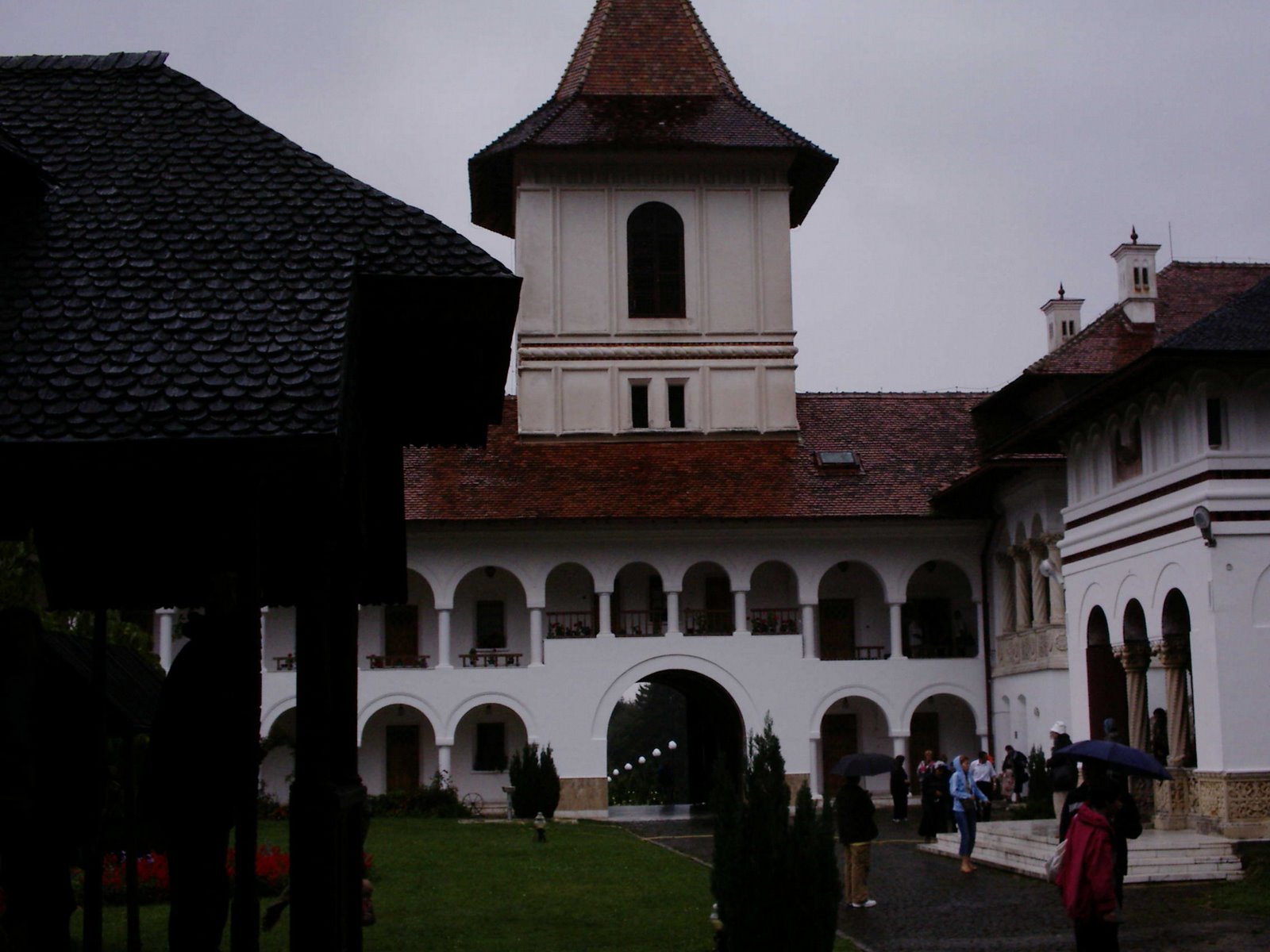
An orthodox monastery (though in Romania, not Russia)

This is a huge and complex book and it seems impossible to summarise it in a review. These are my preliminary impressions.

The size of the book
On first impressions, it is dauntingly big. Dostoevsky liked words and never used one when a dozen were available. It could have been shorter. And we must bear in mind what E M Forster, in Appendix A of Aspects of the Novel, says: “Long books, when read, are usually overpraised, because the reader wishes to convince others and himself that he has not wasted his time.” But, on the other hand, The Brothers Karamazov is often thought to be Dostoevsky’s masterpiece and is generally regarded as a classic of Russian literature. I suspect that is because it endeavours to do so many things.

A murder mystery?
The plot revolves around the murder of a rich old man, Fyodor Karamazov and the subsequent arrest and trial of one of his sons, Dmitry. It was said to have been inspired by a real case involving a man Dostoevsky knew when he was in exile in Siberia; this man was wrongfully convicted and subsequently exonerated of parricide.

It’s not a murder mystery in the conventional sense in that there are only two suspects, Dmitry and the villainous Smerdyakov, and the reader is pretty certain whodunnit. But it follows other tropes almost perfectly. Before the crime, Smerdyakov explains to Ivan, the middle brother, how it can be committed. When Dmitry is in the garden of his father’s house at night, clutching a weapon, there is a pause in the action ... and then he is fleeing the scene and being accused of parricide by an old servant whom he strikes. After the crime, there is a police investigation and the evidence is thoroughly dissected. The novel ends in a courtroom drama. This is classic stuff.

A retelling of the myth of Oedipus?
In some ways Dostoevsky’s story is a retelling of the Oedipus myth. Dmitry was abandoned by his father when he was very young and brought up initially by a servant and then a rich relative far away, as Oedipus was abandoned by Laertes, and taken in by poor folk and subsequently a foreign king. (At Dimitry’s trial the Defence Counsel makes much of this, suggesting that fatherhood is a two-way thing and therefore that this murder can’t be called parricide.) Oedipus accidentally marries his mother; Dmitry is in love with Grushenska, a woman also wooed by his father. So there are links. And Ivan the middle brother also harbours murderous thoughts towards his father, exclaiming (at Dmitry’s trial): “Who does not desire the death of his father?” (12.5) And the alternative suspect for the murder is allegedly the illegitimate son of Fyodor (a bit of a nineteenth-century cliche: always blame the bastard). So TBK has plenty for Freud to get his teeth into.

A romantic farce?
Not only are Dmitry and his father wooing the same woman, Grushenska, but Dmitry is already engaged to Katerina who, in turn, loves and is loved by Dmitry’s brother Ivan (sibling rivalry?). Grushenka is a notorious woman, having an old merchant ‘protector’ and having been ‘dishonoured’ when she was young by a Polish officer after whom she still secretly hankers. Ratikin is courting (for her money) Mrs Khakhlakov but she fancies Perkhotin.

A theological debate
If there is a hero, it is Alyosha, the third and youngest legitimate brother. At the start of the book, he is a monk in the local monastery but he spends an awful lot of his time visiting various different people around the town and therefore acting as a sort of thread binding the story together (although the principal narrator is an anonymous monk living in the monastery).

One of the major subplots involves Alyosha’s mentor at the monastery, the Elder Zosima, a sort of wise guru whose sayings and prophecies are suitable gnomic but whose reputation as a holy man takes a severe knock after he dies and his body goes putrid and smells (the body of a saint is supposedly incorruptible). Another subplot involves Alyosha effecting a reconciliation between warring schoolboys.

His elder brother, Ivan, is an academic and an atheist who has recently published an infamous article which suggests that if there is no God, then everything is lawful. His atheism isn’t absolute. He entertains the possibility of there being a God, but he finds it difficult to believe that this world is that created by God. The root of his disbelief stems from the fact that children suffer and this cannot be reconciled with the idea that compassion is at the heart of Christianity. Ivan is the focus of the theological debates in the book. He is the one who makes up the tale of the Grand Inquisitor which is perhaps the most famous part of the book: Jesus appears in fifteenth century Spain and is arrested and interrogated by the Grand Inquisitor who explains why giving mankind free will was a mistake. Ivan also hallucinates a conversation with the devil.

A book about redemption?
Dmitry realises that the only way he will reform is by spending twenty years in the Siberian mines and therefore he seems to believe that he possesses a nugget of redeemable character. Is this Dostoevsky suggesting that purgatory is the place where souls are redeemed on their way to paradise?

A prematurely postmodern psychological novel
Dostoevsky seems to me to be way ahead of his time in his understanding that people are inconsistent. To take a trivial example: a young girl called Lise (later called Liza) writes a love letter to Alyosha which she then repudiates, telling him it was a silly joke and then repudiates the repudiation, saying she loves him after all.

Dmitry is a more important example. He is a libertine and by his own (frequent) admission a scoundrel but he has a fine sense of honour and he insists he is not a thief. When he has money he splurges it and yet he keeps 1,500 roubles sewn into a bag around his neck. He gets drunk and enjoys women and yet at the same time he is desperately in love with Grushenska. The straight and narrow road is not for him: “I always liked side‐paths, little dark back‐alleys behind the main road—there one finds adventures and surprises, and precious metal in the dirt. I am speaking figuratively, brother. In the town I was in, there were no such back‐alleys in the literal sense, but morally there were. If you were like me, you’d know what that means. I loved vice, I loved the ignominy of vice.” (3.4)

Perhaps the most fascinatingly complex character is Kolya. He’s a clever schoolboy and he knows it. He’s vain but sufficiently self-aware to know when he is being boastful. He has rudimentary ideas of socialism and likes talking to the people but he is very patronising when he does. His school fellows admire him as a daredevil because of some of his pranks but he finds it a strain keeping this reputation up. He has a tender heart and is very fond of some young children whom he occasionally babysits. He hates his own name (Nikolay). He talks to Alyosha on equal terms (he calls him ‘Karamazov’) but he knows that Alyosha somehow sees Kolya’s naked soul.

Not all the characters are multi-dimensional. Fyodor Karamzov, the father, enjoys being a sensualist, he boasts about it. He explains to Alyosha why he needs his money: “As I get older, you know, I shan’t be a pretty object. The wenches won’t come to me of their own accord, so I shall want my money. So I am saving up more and more, simply for myself .... For I mean to go on in my sins to the end, let me tell you. For sin is sweet; all abuse it, but all men live in it, only others do it on the sly, and I openly. And so all the other sinners fall upon me for being so open. And your paradise, Alexey Fyodorovitch, is not to my taste, let me tell you that; and it’s not the proper place for a gentleman.” (4.2) At the start of the book Dostoevsky suggests that Fyodor accumulated his wealth by sponging, so that everyone always underestimated how rich he was, he also indulges in sharp practices (marrying for money and effectively cheating Dmitry out of his mother’s inheritance); by the time of the action of the novel, however, Fyodor has a reputation for being a rich voluptuary. Is this an inconsistency in the story or is Dostoevsky showing that even when a character is consistent, their reputation can be multi-faceted.

At the end of the book, at the trial, both Prosecutor and Defence Counsel interpret the actions of Dmitry in different ways: as the Defence says “psychology, gentlemen, though it is a deep thing, none the less resembles a stick with two ends” (12.10). It is pointed out that the lawyers are constructing competing stories. It is as if Dostoevsky is saying that there is no absolute truth but that all versions of reality are unreliable narrations, a very postmodern idea.

The unreliable narrator is also a trope of modernist fiction, so perhaps TBK is an early example of that. The ending of the book, which is only partially resolved, is another characteristic of modernism. 

Characters
In the end, the joy of TBK lies in some of the characters. Although I found Alyosha rather empty and bland and Smerdyakov is a purely pantomime villain, other characters are fascinating. My favourites were Mrs Khokhlakov, a wonderfully empty-headed widow, and the brilliant but vain but compassionate Kolya. At the other end of the age spectrum, who doesn't love an unredeeemed rake who takes joy in his wickedness, such as Fyodor Karamzov?

But perhaps the most interesting character is Ratikin. At the start he is almost unnoticeable, the seminarian in the background. But little by little he worms his way into the plot until he is a cross between a secret policeman and an agent provocateur. He is a spy for Mrs K. He takes money from Grushenska to bring Alyosha to her. He pops up everywhere! “It turned out that Ratikin knew everything, knew an extraordinary amount, had been to visit everyone, seen everything, spoken to everyone, and possessed a most detailed knowledge.” (12.2) Is he Dostoevsky's cynical self-portrait, like Velasquez in his Las Meninas? He writes slanderous articles (betraying Mrs K) for the Moscow press when the scandal of the murder breaks. Dmitry even says “He wants to write about me ... and thus inaugurate his role in literature.” (11.4) 

What I didn’t like
As with so many Russian novels, each character has three names: the first name, the patronymic and the surname. They are referred to either by first name and patronymic (eg Fyodor Pavolich) or by surname (eg Karamazov) or, most frequently, by a version of their first name (eg Alyosha, Mitya, Katya, etc). Some characters have more than one such nickname (often different people call them different things and this is a highlight of the book). In some cases we don’t learn the full name of a character until very late on in the book. This caused me considerable confusion at the start, not realising, for example, that Grushenska was also called Agrafena Alexandrovna. I really needed a cast list at the start of the book which listed all possible versions of their name.

The edition I had came with notes which often explained things that I wasn’t very interested in, such as the fact that a certain line was derived from a parody of Pushkin. What I absolutely needed was a translation of the many times that French or Latin was used. In the worst example, the devil tells a joke in French. There is an end-note ... which gives the full joke, still in French, and fails to translate it! Why do editors do this? I’m reading a translation ... but they can’t be bothered to translate anything that’s not Russian. Is it because they don’t know? Or is it because they do know and they expect me to know? Or is it because they do know and they know I don’t know and it is a way of asserting their superiority?

The implication that Smerdyakov was a rotter principally because he illegitimate. All of Fyodor Karamazov's sons get a rough start in life but poor old Smerdy is bullied and looked down on by everyone. The whole Russian economy depends on the peasants but, despite Dostoevsky's reputation as a revolutionary social reformer, his books are basically about the upper-classes, who are presumed, even when they are ill-educated and poverty-stricken, to be intrinsically nobler and worthier and better than the muzhiks. 

All those exclamation marks! There's only so much intensity that one can take. Dmitry lives his life in the fast lane, always seemingly on the edge of catastrophe, and Ivan seems perpetually on the brink of a nervous breakdown. Alyosha spends his time running from one crisis to another. It's like watching Macbeth when everyone shouts every line, or a ballet when the dancers never pause. Exhausting! The occasional funny bits, such as when Mrs K tries to interest Dmitri in gold mines, are a welcome relief. 

The narrative was somewhat lumpy. Two whole books (6 and 10) were almost extraneous additions. Book 6 tells of the life and works of the Elder Zosima and is almost completely irrelevant to the plot. Book 10 introduces a new character and acts as an interlude between Dmitry's arrest and his trial.

And, while I appreciate that every character needs a back story, does every character need that back-story told? I suppose these sometimes provided welcome breaks from the intensity of the action but I really didn't need to know, for example, why Zosima became a monk.

Evaluation
Yes it is much too long. There were passages of intricate theological and legal argument when I was numb with weariness. But even an inadequate review like the one above must give some idea of the wealth that is in this book. A classic? Undoubtedly.

Selected quotes:
  • “The more I love mankind in general, the less I love human beings in particular. ... In the space of a day and a night I am capable of coming to hate even the best of human beings: one because he takes too long over dinner, another because he has a cold and is perpetually blowing his nose.” (2.4)
  • “All these deportations to forced labour, ... reform no one, and more importantly have no deterrent effect, either.” (2.5)
  • “It had rats, but Fyodor Pavlovitch did not altogether dislike them. ‘They help to relieve the monotony when one’s alone in the evening,’ he used to say.” (3.1)
  • “But I always liked side‐paths, little dark back‐alleys behind the main road—there one finds adventures and surprises, and precious metal in the dirt. I am speaking figuratively, brother. In the town I was in, there were no such back‐alleys in the literal sense, but morally there were. If you were like me, you’d know what that means. I loved vice, I loved the ignominy of vice.” (3.4)
  • “The ladder’s the same. I’m at the bottom step, and you’re above, somewhere about the thirteenth. That’s how I see it. But it’s all the same. Absolutely the same in kind. Anyone on the bottom step is bound to go up to the top one.” (3.4)
  • “As I get older, you know, I shan’t be a pretty object. The wenches won’t come to me of their own accord, so I shall want my money. So I am saving up more and more, simply for myself,.... For I mean to go on in my sins to the end, let me tell you. For sin is sweet; all abuse it, but all men live in it, only others do it on the sly, and I openly. And so all the other sinners fall upon me for being so open. And your paradise, Alexey Fyodorovitch, is not to my taste, let me tell you that; and it’s not the proper place for a gentleman.” (4.2)
  • “Even in these days the law does not allow you to drag your old father about by the hair, to kick him in the face in his own house, and brag of murdering him.” (4.2)
  • “In schools, children are a tribe without mercy: on their own they are heaven’s own angels, but together, especially in schools, they are often merciless.” (4.7)
  • “The very kindest and best of men are those who are most drunk.” (4.7)
  • "If I didn’t believe in life, if I lost faith in the woman I love, lost faith in the order of things, were convinced in fact that everything is a disorderly, damnable, and perhaps devil‐ridden chaos, if I were struck by every horror of man’s disillusionment—still I should want to live and, having once tasted of the cup, I would not turn away from it till I had drained it! At thirty, though, I shall be sure to leave the cup, even if I’ve not emptied it, and turn away—where I don’t know. But till I am thirty, I know that my youth will triumph over everything—every disillusionment, every disgust with life. I’ve asked myself many times whether there is in the world any despair that would overcome this frantic and perhaps unseemly thirst for life in me, and I’ve come to the conclusion that there isn’t, that is till I am thirty, and then I shall lose it of myself, I fancy. Some drivelling consumptive moralists—and poets especially—often call that thirst for life base. It’s a feature of the Karamazovs, it’s true, that thirst for life regardless of everything; you have it no doubt too, but why is it base? The centripetal force on our planet is still fearfully strong, Alyosha. I have a longing for life, and I go on living in spite of logic.” (5.3)
  • “And so Our Lady, shocked and weeping, falls before the throne of God and begs for mercy for all in hell—for all she has seen there, indiscriminately.” (5.5)
  • “We had four servants, all serfs. I remember my mother selling one of the four, the cook Afimya, who was lame and elderly, for sixty paper roubles, and hiring a free servant to take her place.” (6.1)
  • “Much knowledge soon makes one old.” (7.3)
  • “He felt unbearably awkward. All were clothed, while he was naked, and strange to say, when he was undressed he felt somehow guilty in their presence, and was almost ready to believe himself that he was inferior to them, and that now they had a perfect right to despise him.” (9.6)
  • “I have, as it were, torn my soul in half before you, and you have taken advantage of it and are rummaging with your fingers in both halves along the torn place.” (9.7)
  • “I’ve sworn to amend, and every day I’ve done the same filthy things. I understand now that such men as I need a blow, a blow of destiny to catch them as with a noose, and bind them by a force from without. Never, never should I have risen of myself! But the thunderbolt has fallen. I accept the torture of accusation, and my public shame, I want to suffer and by suffering I shall be purified. Perhaps I shall be purified, gentlemen?” (9.9)
  • “The study of the classics, if you ask my opinion, is a police measure, that’s why it has been introduced into our schools. Latin and Greek were introduced because they are a bore and because they stupefy the intellect. It was dull before, so what could they do to make things duller? It was senseless enough before, so what could they do to make it more senseless? So they thought of Greek and Latin.” (10.5)
  • “Everything will change , and finally, nothing, they will all be old men staring into their coffins.” (11.2)
  • “Everyone says they hate immorality, yet secretly they all like it.” (11.3)
  • “De thoughtibus non est disputandum.” (11.4) It’s a rewrite of the philosophical maxim: de gustibus non est disputandum which means ‘you can’t argue over matters of taste’ (that is, if I like something and you don’t, you can’t dispute it) Dostoevsky’s maxim, put into the mouth of Dmitri, is ‘you can’t argue over thoughts ie philosophies’
  • “How is man to fare after that? Without God and without a life to come? After all, that would mean that now all things are lawful, that one may do anything one likes.” (11.4)
  • “Just try admitting to a woman your guilt ... On no account will she forgive you in a simple, straightforward manner, no, she will degrade you to the level of the floor-cloth, she will find things that never even happened, will take everything, forget nothing, add things of her own, and only then forgive.” (11.4)
  • “What would become of an axe in space? Quelle idée! If it were to fall to any distance, it would begin, I think, flying round the earth without knowing why, like a satellite.” (11.9)
  • “Who does not desire the death of his father?” (12.5)
February 2024; 985 pages

Other books by Dostoevsky include:


This review was written by

the author of Bally and Bro, Motherdarling 

and The Kids of God


Thursday, 25 January 2024

"The Guide" by R K Narayan


The Guide follows Raju. We first meet him after he comes out of prison; sitting on the river bank near a village called Mangal, he encouters a villager, Velan, who believes he is a holy man. He maintains this illusion in return for gifts of food and being allowed to sleep in the temple. But when there is a drought, the swami is expected to be a saint and fast. He tries to persuade Velan he is an ordinary man by telling him how he came to be in jail. he used to run a shop in Malgudi's railway station and then became a tourist guide. He fell in love the the wife of one of his clients and then became her manager as she became a dancer.

Raju is clearly a men who lives on his wits. He has the skills of a con artist: he is able to discern what people want and convince them that he can satisfy their needs. At the same time, he is (usually) convinced that he is a good man doing the right thing. Perhaps it is only afterwards that, reflecting on his life, he achieves self-awareness. As an accidental swami, he starts to realise that he is taking advantage of the innocence of the villagers (although that doesn't stop him cheating them when he needs to).

The strength of the book lies in its depiction of life in the town of Malgudi and the village of Mangal. It is a society where religion is important but life is more important. Good manners and decent behaviour are expected, status are reputation are highly prized. There is a deep respect for rules and for the law, which contrasts strongly with an economy seemingly based on more or less unfettered free enterprise (a bit like the USA where rampant capitalism is paired with a furiously, litigious society).

Narayan's prose is very matter-of-fact, as is the story he is telling. This is a story of an ordinary man, told in ordinary words; the degree of verisimilitude is such that I, as reader, wouldn't have been surprised to encounter Raju in the street, and for that street to have all the sights and sounds and smells of an Indian town. And yet Narayan includes very little description in his book. We know very little about what any character looks like (we know that Raju came out of prison with short hair and later grew it) or what either Malgudi or Mangal look like and nothing about the sounds and smells. In this sense, Narayan is a minimalist and, like a radio player can create pictures in a listeners head, he is able to conjure up a sense of solid reality despite offering few details. This light touch helps to make Raju feel both individual and an everyman.

The chronology of the book jumps between the present (Raju as a fake swami) told in the third person and the past (Raju as a tourist guide and then an impresario, told in the first person). Raju has an interesting relationship with the past. Raju is besotted by Rosie, a dancer from a family of temple dancers whose husband has forbidden her to dance but who wants to popularise the cultural tradition of dance. Rosie's husband is fascinated by ancient artefacts and writes an important book on them. Raju himself, whose story starts with that symbol of contemporary India, the railway station, ends up as a swami combatting drought, perhaps the most ancient and yet timeless symbol of India. It is almost as Narayan is telling us that everything changes but everything remains the same, that time clothes us but that our naked selves are eternal.

The title 'The Guide' seems at first glance to refer purely to Raju's time as a tourist guide. But, of course, he ends up as a spiritual guide. He started off as an imposter, propelled into guiding by tourists who asked for him to help them and winging it all the way but in the end providing a service so valuable that he receives a begrudging acknowledgement in Rosie's husband's book. In the same way he only becomes a swami because Velan mistakes him for one, and he is a thoroughgoing fraud at the start but in the end we feel he has become a genuine saint. 

Raju's career matches the life-course of Hermann Hesse's eponymous hero in Siddhartha - a story based on the life of the Buddha - whose search for enlightenment includes becoming a merchant and a lover before ending as a ferryman, living by a river.

A Penguin Classic. Narayan was an Indian writer who write a series of novels set in the fictional Indian town of Malgudi. In Britain, where he first achieved success, he was championed by a young Graham Greene and one can feel the kinship between Greene's novels and Narayan's. 

Selected quotes:
  • "The essence of sainthood seemed to lie in one's ability to utter mystifying statements. ... He was dragging these innocent men deeper and deeper into the bog of unclear thoughts." (Ch 4)
  • "It seemed to me silly to go a hundred miles to see the source of [the river] Sarayu when it had taken the trouble to tumble down the mountain and come to our door." (Ch 5)
  • "If he was the academic type I was careful to avoid all mention of facts and figures and to confine myself to general descriptions, letting the man himself do the talking. You may be sure he enjoyed the opportunity." (Ch 5)
  • "True to the tradition of the landed gentry, he found litigation an engrossing subject." (Ch 8)
January 2024; 196 pages

Narayan also wrote The Painter of Signs, reviewed in this blog


This review was written by

the author of Bally and Bro, Motherdarling 

and The Kids of God


Wednesday, 24 January 2024

"Love's Labour's Lost" by William Shakespeare

 One of Shakespeare's comedies. 

The King of Navarre persuades three of his Lords to abjure women and study philosophy together for a period of three years; they all swear to do this although Berowne is reluctant. They then realise they must immediately break their oaths because the Princess of France and three ladies have arrived on a diplomatic mission. They meet the ladies and fall in love but, before they can  all go off happily into the sunset, or to bed, a messenger tells the Princess that her dad is dead so they must all endure a period of mourning for a year and a day. These courtly romances, enlivened by the usual mistaken identities and misdirecting of love letters, are repeatedly interrupted by the lower class.

Much of the humour relies on wordplay, making this play a challenge for the reader (I often needed to check the notes) and the audience. On the whole, it was heavy going and it is generally regarded as one of Shakespeare's lesser works. 

There's a lot of poetry in it (including a sonnet in Alexandrine hexameters). Well over one third of all the lines are rhymed , more than any other Shakespeare play (the next contenders are Richard II and The Midsummer Night's Dream). 

It also contains 189 proverbs, beaten only by Romeo & Juliet (223) and King Lear (197). 

Most of Shakespeare's plays are clearly sourced but LLL isn't and it shares the same number of scenes (9) as the other unsourced plays: The Midsummer Night's Dream and The Tempest.

Some of the lower class characters seem to share characteristics with the Commedia dell'Arte. For example, Armado is a Braggart and Holofernes a Pedant.

Selected quotes:
  • "O, I am stabbed with laughter." (5.2.80)
  • "Light seeking light doth light of light beguile." (1.1.77) It was thought that eyes saw by shining a light out of themselves.
  • "Small have continual plodders ever won,/ Save base authority from others' books." (1.1.86 - 87)
  • "Assist me, some extemporal god of rhyme, for I am sure I shall turn sonnet. Devise, wit; write, pen; for I am for whole volumes in folio." (1.2.175 - 177)
  • "To jig off a tune at the tongue's end, canary it with your feet, humour it with turning up your eyelids, sigh a note and sing a note, sometime through the throat as if you swallowed love with singing love, sometime through the nose as if you snuffed up love by smelling love, with your hat penthouse-like o'er the shop of your eyes, with your arms crossed on your thin-belly doublet like a rabbit on a spit, or your hands in your pocket like a man after the old painting; and keep not too long in one tune, but a snip and away." (3.1.10 - 20)
  • "A lover's eyes will gaze an eagle blind." (4.3.308)
  • "Love's feeling is more soft and sensible/ Than are the tender horns of cockled snails." (4.3.311 - 312)
  • "A time methinks too short/ To make a world-without-end bargain in." (5.2.782 - 783)
One of my mum's favourite poems comes from a song at the end of LLL:
When icicles hang by the wall
And Dick the shepherd blows his nail
And Tom bears logs into the hall
And milk comes frozen home in pail,
When blood is nipped and ways be foul, 
Then nightly sings the staring owl:
'Tu-whit, Tu-whoo!' A merry note,
While greasy Joan doth keel the pot.

When all aloud the wind doth blow
And coughing drowns the parson's saw
And birds sit brooding in the snow
And Marian's nose looks red and raw,
When roasted crabs hiss in the bowl, 
Then nightly sings the staring owl:
'Tu-whit, Tu-whoo!' A merry note,
While greasy Joan doth keel the pot.

I saw a production of LLL by the Eastbourne Operatic & Dramatic Society at the Eastbourne Royal Hippodrome on Friday 26th January 2024. My review is here.

I also saw a more or less straight-from-the-text LLL streamed on Digital Theatre from a 2015 Stratford Festival production. 

Other Shakespeare plays that I have reviewed can be found here.

January 2024


This review was written by

the author of Bally and Bro, Motherdarling 

and The Kids of God

Tuesday, 23 January 2024

"The Color Purple" by Alice Walker

 An epistolary novel of a sort in that the story is told as if the protagonist Celie is writing letters to God. This has the advantage that the novelist can use the conceit that they don't know what is about to happen next. But, despite the careful use of mis-spelt words to give an authentic feel, these snippets have too much controlled narrative to sound like letters. Later, there are letters written to Celie. These are even more obviously contrived.

Nevertheless, the voices of the two main characters, Celie and Shug, come through very strongly.

One of my problems with this book is that it is issue driven. We start off with child sexual abuse; it almost feels that the author has contrived to select a hook with the biggest shock value. Then the protagonist is married off to a man who wants a wife to work for him and to have sex with; he beats her. Before too long we have lesbianism, racism, colonialism, slavery, the true origin of the Uncle Remus stories, lynching, female circumcision ... It is almost as if the author can't think of an issue without being compelled to add it to the story. This means that some of the characters (eg Nettie) simply become channels to report on these things. This reduces them from potentially three-dimensional characters into mouthpieces.

There are characters. The core of the book involves the narrator, Celie and her relationship with Shug, a jazz singer who is Celie's husband's former lover and occasional boyfriend. It is by observing how Shug confronts the world that Celie learns how to stop being exploited, downtrodden and abused. There are also two other characters: Harpo, Celie's stepson and his wife Sofia, who have an on-off relationship. Harpo tries hard to treat Sofia better than his father treats his stepmother; Sofia version of standing up to the world gets her into trouble that even she can't handle. These four characters could have made an excellent novel on their own, but every time Nettie shows her face she preaches.

The other interesting character is that of Mr ------, Celie's husband. He's very much the villain at the start. Then we discover that when he was in love with Shug, he was a different person. By the end of the book he is tamed. He is not the only baddie to be redeemed. It is almost as if the author is saying that if you are true to yourself, if you stand up for yourself, then in the end goodness and righteousness will prevail. It makes a book that started with a shock into a feel-good novel by the end. But I found such redemptive character arcs unconvincing.

A potentially great novel spoiled by too many issues, too much plot and too little concentration on the characters. 

Selected quotes: 

(page references refer to the Wiedenfeld & Nicolson paperpack published in 2017)

  • "I don't know how to fight. All I know how to do is stay alive." (p 18)
  • "Next time us see Harpo his face a mess of bruises. His lip cut. One of his eyes shut like a fist. He walk stiff and say his teef ache." (p 36) I love the eye that is 'shut like a fist'; both descriptive and hinting at the reason for his injury.
  • "She weak as a kitten. But her mouth just pack with claws." (p 47)
  • "Harpo sits on the steps acting like he don't care. He ... whistle a little tune. But it nothing compared to the way he usually whistle. His little whistle sound like it lost way down in a jar, and the jar in the bottom of the creek." (p 64)
  • "She wearing a skintight red dress look like the straps made out of two pieces of thread." (p 69)
  • "'Tea' to the English is really a picnic indoors." (p 123)
  • "Nobody feel better for killing nothing. They feel something is all." (p 129)
  • "There is a way that the men speak to women that reminds me too much of Pa. They listen just long enough to issue instructions." (p 146)
  • "The God I been praying and writing to is a man. And act just like all the other mens I know. Trifling, forgitful and lowdown." (p 173)
  • "You better hush. God might hear you. Let 'im hear, I say. If he ever listened to poor coloured women the world would be a different place, I can tell you." (p 173)
  • "Have you ever found God in church? I never did. I just found a bunch of folks hoping for him to show. Any God I ever felt in church I brought in with me." (p 174)
  • "I think it pisses God off if you walk by the color purple in a field somewhere and don't notice it." (p 177)
  • "People think pleasing God is all God care about. But any fool living in the world can see it always trying to please us back." (p 177)
  • "Everything want to be loved. Us sing and dance, make faces and give flower bouquets, trying to be loved. You ever notice that trees do everything to git attention we do, except walk?" (p 177)
  • "Every time I conjure up a rock, I throw it." (p 178)
  • "I don't know who tried to teach him what to do in the bedroom, but it must have been a furniture salesman." (p 225)

January 2024; 261 pages

The Color Purple won the Pulitzer Prize in 1983.


This review was written by

the author of Bally and Bro, Motherdarling 

and The Kids of God

Saturday, 20 January 2024

"Still Life" by Sarah Winman

Caravaggio's Basket of Fruit (public domain)

The Waterstone's Book of the Month for March 2022.

A brilliant book. A group of oddball characters travel from a grey 1950s London pub setting to a technicolor Florence. There's a lot of banter, a lot of humour (I laughed aloud at several points, which I rarely do), some moments of sadness (I cried when one of the leading characters died) and a message that life is to be enjoyed.

I read it shortly before watching the film, Poor Things and this book and that film share (with Caravaggio) an artificiality of style coupled to extreme naturalism. This is signposted right from the start. In the first part (Man is the Measure of All Things 1944), a critical meeting between Evelyn and Ulysses which includes dialogue which sounds like sort of thing you wish you'd said at a posh dinner party if you hadn't drunk too much of that wonderful wine, is sandwiched between two sections where the dialogue has perfect verisimilitude, each speaker making short contributions which are often beside the point and fail to respond to the other speaker. During the middle section, the art movement Mannerism is mentioned ("the style is what we would call early Mannerist. ... a deliberate denial of realistic style, calculated and artificial.") and I think this is a clue to what the author is trying to do. 

Which is a fascinating start.

The deliberate artificiality continues. There is a cast of eccentric characters, swiftly but indelibly drawn, including:

  • Ulysses Temper, an incurably optimistic soldier from London whose superpower is making friends
  • Evelyn Skinner, a lesbian art critic
  • Peg, a brassy barmaid with attitude 
  • Cressy, an old man who has dialogues with trees and an interest in philosophy; he has visions which lead to extraordinarily successful betting coups
  • Pete the pub piano player and composer and occasional star of musical theatre, who has girlfriends across Europe
  • Claude, a parrot who quotes Shakespeare
  • Alys, the result of a one night stand between Peg and a GI, a kid with attitude growing up in Florence
  • A cherry tree with a long perspective on time a farewells: a cherry tree "Think about it. Leaves." (Somewhere Between an Atom and a Star 1946 - 53)
  • Col, the pub landlord, violently protective of his daughter who drives a second-hand ambulance which has a misfiring siren (in the UK ambulances had bells before 1963 which I presume is not an error but a deliberate introduction of artificiality).     
  • Des, a businessman who can't help making money: "Two words ... disposable syringes"
This is a book about the joy that is in life. It is a joyous read.

Selected Quotes:

  • "He was a recent scholar ... Covered in the afterbirth of graduation - shy, awkward, you know the type. Entering the world with no experience at all." (Man is the Measure of All Things" 1944)
  • "A meagre stain in the corridors of history, that's all we are." (Man is the Measure of All Things" 1944)
  • "Hair of the dog, she thought; she'd need the whole bleedin' pelt to get moving this morning."  (Man is the Measure of All Things" 1944)
  • "Cherry blossom and a glass of stout. Hard to beat." (Somewhere Between an Atom and a Star 1946 - 53)
  • "The world never turned out the way that you wanted it to. It simply turned. And you hung on." (Somewhere Between an Atom and a Star 1946 - 53)
  • "I've never seen him in a hat before ... Me neither.  .... It'd look even better on his head." (The Stuff of Dreams 1953 - 54)
  • "The salty porky chickeny-ness of it, said Col in a moment of rare epicurean elegance."  (The Stuff of Dreams 1953 - 54)
  • "The music led Cress to his mum. Six kids, no money and only a view from the sink. Christmas just another day. The time he learnt that she too had dreams. Hard to reconcile that pain. Had taken a lifetime and still not there yet." (The Stuff of Dreams 1953 - 54)
  • "They left the next day, Peg and Ted as early as decency would allow, and the margins on that were close."  (The Stuff of Dreams 1953 - 54)
  • "She looked at her watch. Curtailed, once again, by the scythe of time." (The Most Unlikely-Looking Pair 1954-59)
  • "The was an herbaceous hook to the spring air, the slow roll of a lawnmower moving methodically across the quad. It was the season of bloom and leaf growth, and the bare branches appeared bewildered by the vibrancy of emerging livery." (The Most Unlikely-Looking Pair 1954-59)
  • "Time: mid-morning. Weather: sun blazing, no respite, no cloud. Gasping."  (The Most Unlikely-Looking Pair 1954-59)
  • "She was a Michelangelo enthusiast and spent hours gazing at David's allure." (La Dolce Vita 1960)
  • "Sunglasses hid the ten years older and the sun highlighted the ten years blonder." (It's Just the Way of Things 1962 - 66)    
  • "He was still worried about the age difference, but the elderly contessa reassured him, saying, As long as there's still grass on the pitch ..." (I'd Love Nothing in the World So Well As You 1968 - 79)
  •  "She taught Pete the stuck-in-a-glass-box mime routine and Pete spent the following week trying to escape from something he couldn't see."  (I'd Love Nothing in the World So Well As You 1968 - 79) Metaphorical?
  • "His nudes look absent-minded, as if they've carelessly lost their clothes and need to go and search for them." (All About Evelyn)
  • "So, time heals. Mostly. Sometimes carelessly. And in unsuspecting moments the pain catches and reminds one of all that's been missing. The fulcrum of what might have been. But then it passes. Winter moves into spring and swallows return. The proximity of new skin returns to the sheets. Beauty does what is required. Jobs fulfil and conversations inspire. Loneliness becomes a mere Sunday. Scattered clothes. Empty bowls. Rotting fruit. Passing time. But still life in all its beauty and complexity."  (All About Evelyn) I wonder whether the reference to rotting fruit hints at the Caravaggio Still Life which shocked viewers when it showed fruit past its eat-by date? Caravaggio's hyper-realistic style was in many ways a reaction against Mannerism while still maintaining a dramatic artificiality of composition, particularly in regard to his heightened 'tenebrist' lighting effects. 

Wonderful. I must read more by this brilliant author.

January 2024; 436 pages


This review was written by

the author of Bally and Bro, Motherdarling 

and The Kids of God

Tuesday, 16 January 2024

"Silver on the Tree" by Susan Cooper


 In the final instalment of 'The Dark is Rising', all the characters from the previous books come together to defeat the powers of darkness. Will and Bran (whose true nature is divulged) have to travel through time to the Lost Land where they will undergo a series of tests in order to win a sword. Simon, Barnaby and Jane have rather more minor roles. Great Uncle Merriman acts as guide and controller. The most important scene is given to a bit player, the ordinary human sheep farmer John Rowlands.

The book is the opportunity for the author to display her descriptive powers:

  • "Grasshoppers skirled unseen from the grass, chirruping their solos over the deep summer insect hum" (1: Midsummer’s Eve)
  • "Oak and sycamore and Lombardy poplar reached high on either side; houses slept behind hedges fragrant with honeysuckle and starred with invading bindweed." (1: Black Mink)
  • "the face was fine-boned, kindly yet arrogant, with clear blue eyes that shone strangely young in the old, old cobweb-lined face." (2: The Bearded Lake)
She also delightfully captures the rhythm and structure of spoken Welsh.

Many weird and wonderful things take place; it is clear that the author possesses .considerable powers of imagination. This, I suspect, is this book is loved by so many.

But the fact that Will is able to do magic, and immortal, and the promise repeatedly made by Merriman that there is no mortal peril, undermines the tension of the book. We know things are going to be all right so that the monsters and the horrors fail to terrify. And, as with the other books, no test is ever failed. Everything is too straightforward.

At the end there are two decisions made that could go either way and these stand out for me as the moments when the book escaped from being no more than a decorative fairy tale and nudged its way towards being a myth.

The initial relationship between Bran and a newly pubescent Jane also produced some moments of edginess, although the rift between Will and Simon which was a feature of book 3 had healed. The character of the King of the Lost Land was also one of the strengths of the book.

Of course, this is a children's book and I am judging it by adult standards. But for my money this book, though prettily written, was too tame.

Selected quotes:
  • "it cures the toothach being snift up into the nosethrils, especially into the contrary nosethril." (1: Midsummer’s Eve)
  • "For all times coexist, you said, and the future can sometimes affect the past, even though the past is a road that leads to the future." (1: Black Mink)
  • "The mindless ferocity of this man, and all those like him, their real loathing born of nothing more solid than insecurity and fear . . . it was a channel. Will knew that he had been gazing into the channel down which the powers of the Dark, if they gained their freedom, could ride in an instant to complete control of the earth." (1: Midsummer Day)
  • "If you have seen the raising of fear, and the killing of love, and the Dark creeping in over all things, you do not ask stupid questions. You do what you are intended to do, and no nonsense." (2: The Bearded Lake)
  • "there was more than a mood invading her mind; this was a strangeness she could not define, had never known before. A restlessness, a half-fearful anticipation of something part of her seemed to understand and part not . . ." (2: The Bearded Lake)
  • "Maybe because the Dark can only reach people at extremes – blinded by their own shining ideas, or locked up in the darkness of their own heads." (3: The Rose-Garden)
  • "For ever and ever, we say when we are young, or in our prayers. Twice, we say it, Old One, do we not? For ever and ever . . . so that a thing may be for ever, a life or a love or a quest, and yet begin again, and be for ever just as before. And any ending that may seem to come is not truly an ending, but an illusion. For Time does not die, Time has neither beginning nor end, and so nothing can end or die that has once had a place in Time." (3: Caer Wydyr)
  • "my useless life is the empty cawing of a crow, and any talent I once may have had is dead. Let the toys that it made die with it." (3: The King of the Lost Land)
  • "Boy, callow boy, do not speak to me of life that you have not lived. What do you know of the weight that drags down a king who has failed his people, an artist who has failed his gift? This life is a long cheat, full of promises that can never be kept, errors that can never be righted, omissions that can never be filled. I have forgotten as much of my life as I can manage to forget." (3: The King of the Lost Land)
  • "despair, which is the tomb of all your hope" (3: The King of the Lost Land)
  • "‘Cowardly it is,’ he said in a cold adult voice, ‘to shelter behind those who love you, without giving love in return.'" (4: The Train)
  • "Every human being who loves another loves imperfection, for there is no perfect being on this earth." (4: One Goes Alone)
  • "The future cannot blame the present, just as the present cannot blame the past." (4: One Goes Alone)
January 2024

The previous books in the series are:


This review was written by

the author of Bally and Bro, Motherdarling 

and The Kids of God


Sunday, 14 January 2024

"Edward the Elder" by Michael John Kay


The River Great Ouse at Bedford was once the frontier between the Saxons and the Vikings. Edward crossed the river to capture Bedford during his reign.

Edward the Elder was the son of Alfred the Great, King of Wessex. Alfred is justly celebrated for resisting Viking incursions into the territory of Wessex, the Anglo-Saxon kingdom that covered most of southern England, and reaching a long-lasting peace treaty with the Vikings, albeit one that recognised a split between the Anglo-Saxon part of England (Wessex and half of Mercia, the kingdom in the Midlands, against the Welsh border) and the Viking part (called the Danelaw). But Edward was the King who, with his sister Aethelflaed who was Queen of Mercia) took the fight to the Vikings, retrieving the Midlands and East Anglia. Edward's son Aethlestan was to continue the fight, liberating almost all of what is now England, and creating the unified country that we now have.

So Edward (called the Elder by later generations to distinguish him from Edward the Confessor) is a very important figure in English history and one who has been unjustly overlooked, overshadowed, perhaps, by his father. This biography puts Edward back in the limelight.

It also tells his story remarkably well. My only quibble is that the writer frequently tells you the same thing twice, for example, when he describes the boundary between Wessex-Mercia and the Danelaw, the second time in slightly more detail. But if this is the price to pay for a complicated tale to be told with clarity, so be it, although it does make the book longer (and the print is quite small so my ageing eyes found it sometimes wearisome).

It is a complicated tale. A patchwork of Anglo-Saxon kingdoms battled against a miscellany of Scandinavian marauders. The situation was rarely coherent. Given that all this happened over a thousand years ago, the sources are often either missing, possibly inaccurate or incomplete. The author does a great job or pinpointing dates and places without being overly nit-picking (for example, he tends to summarise scholarly opinion without going into the details). The result is a readable history for the general reader.

I loved it. So many of the places that appear are places I have known, such as Kingston-on-Thames were Edward (probably) and Aethelstan (definitely) had their coronations, sitting on a block of sarsen stone. And Bedford, a frontier town, whose Viking stronghold on the northern bank of the River Great Ouse surrendered to Edward, at which point he built a neighbouring fortified burh on the southern bank. And London where, the Roman city having been abandoned, the Vikings ruled Lundenwic before the Saxons retook the city moving the centre (around 883) back to the Roman ruins as Lundenburh. 

But it's not all warfare. There are lots of other interesting tales and mysteries, such as: Why did Edward ditch his first wife Ecgwyn and send his son by that relationship to be brought up by his sister in Mercia? Was she a concubine as was hinted? And why did Edward's first heir die only fourteen days after Edward; was he assassinated by his half-brother? And who was the nun abducted from Wimborne Minster by Edward's cousin Aethelwold during his first rebellion; was she Edward's sister Aethelgifu and did Aethelwold marry her and if so was it consensual?

This is the story of a critical period in the founding of the country we now know as England and this great book rescues Edward from the neglect of history.

Selected quotes:

  • “The slave trade was part of accepted practice, with slaves bought and sold across markets throughout the known world.” (Ch 16)

January 2024; 263 pages


This review was written by

the author of Bally and Bro, Motherdarling 

and The Kids of God