Tuesday, 1 August 2023

"The Invisible Man" by H G Wells


A strange guest arrives at an inn in Iping and takes a room. He always appears in a hat and coat; his face is hidden by heavy glasses and bandages. Glimpse by glimpse, the villagers begin to suspect that something is wrong; eventually they realise that, though his clothes can be seen, his body is invisible. He flees from the village and arrives, by chance, at the house of an old acquaintance, now a doctor. Here he seeks help and tells his back story. But his experiences, and his determined and ruthless personality, have made him angry. Now he decides (like a rather stereotypical 'mad scientist' turned megalomaniac) that he will institute a reign of terror over the surrounding countryside. All he needs is an accomplice.

The brilliance of the book is the way the story is so matter of fact. This might be science fiction but everything is utterly realistic (except the invisibility). The chapters are written as if to accumulate evidence for an inquiry. The descriptions are detailed. The setting is really real: Iping is a real village near Midhurst, in Sussex where Wells as a young man was apprenticed to a chemist. The villagers sound like real Sussexers. The 'scientific' explanation of invisibility, when it comes (and Wells knew that this should be left until quite late in the story) is a mixture of real science (refraction etc) and quasi science with the brilliant addition of a mention of Roentgen who announced his discovery of X-rays (which can see through flesh, making it, as it were, invisible) less than two years before The Invisible Man was published. The style is so utterly mundane that all these truths and facts drown out one's whispers of disbelief about invisibility itself (the fundamental problem is that if a man was invisible he couldn't absorb light on his retinas and therefore he couldn't see, he would be blind).

And there are so many little details that render it utterly matter-of-fact. He stumbles going down the stairs because he can't see his feet. He makes footprints. He can be heard, and smelt by dogs. People bump into him and jostle him because they can't see him. And he has to be naked which, in January, in the snow, is not very practicable. Nor can he eat whilst being watched because the food can be seen inside him (presumably as a squalid mush) until he assimilates it.

This is the textbook way of how to write scifi: make everything else so utterly convincing that the fantasy becomes believable.

And it's great fun to read.

Selected quotes:
  • "the stranger was undoubtedly an unusually strange sort of stranger" (Ch 2)
  • "So it was that on the ninth day of February, at the beginning of the thaw, this singular person fell out of infinity into Iping Village." (Ch 3)
  • "His irritability, though it might have been comprehensible to an urban brain-worker, was an amazing thing to these quiet Sussex villagers." (Ch 4)
  • "The Anglo-Saxon genius for parliamentary government asserted itself; there was a great deal of talk and no decisive action." (Ch 6)
  • "it happens I’m invisible. It’s a confounded nuisance, but I am. That’s no reason why I should be poked to pieces by every stupid bumpkin in Iping, is it?" (Ch 7)
  • "Jaffers clutched at it, and only helped to pull it off; he was struck in the mouth out of the air, and incontinently drew his truncheon and smote Teddy Henfrey savagely upon the crown of his head." (Ch 7)
  • "It continued to swear with that breadth and variety that distinguishes the swearing of a cultivated man." (Ch 8)
  • "Great and strange ideas transcending experience often have less effect upon men and women than smaller, more tangible considerations." (Ch 10)
  • "It was strange to see him smoking; his mouth and throat, pharynx and nares, became visible as a sort of whirling smoke cast." (Ch 17)
  • "Paper, for instance, is made up of transparent fibres, and it is white and opaque only for the same reason that a powder of glass is white and opaque. Oil white paper, fill up the interstices between the particles with oil so that there is no longer refraction or reflection except at the surfaces, and it becomes as transparent as glass. And not only paper, but cotton fibres, linen fibres, wool fibres, woody fibres, and bone, Kemp, flesh, Kemp, hair, Kemp, nails and nerves, Kemp, in fact the whole fabric of a man except the red of his blood and the black pigment of hair, are all made up of transparent, colourless tissue. So little suffices to make us visible one to the other. For the most part the fibres of a living creature are no more opaque than water." (Ch 19)
  • "the place that had once been a village and was now patched and tinkered by the jerry builders into the ugly likeness of a town." (Ch 20)
  • "In going downstairs the first time I found an unexpected difficulty because I could not see my feet" (Ch 21)
  • "Robbing! Confound it! You’ll call me a thief next! Surely, Kemp, you’re not fool enough to dance on the old strings. Can’t you see my position?" (Ch 23)
  • "The more I thought it over, Kemp, the more I realized what a helpless absurdity an Invisible Man was, – in a cold and dirty climate and a crowded, civilized city." (Ch 23)
  • "I went over the heads of the things a man reckons desirable. No doubt invisibility made it possible to get them, but it made it impossible to enjoy them when they are got. Ambition – what is the good of pride of place when you cannot appear there?" (Ch 23)
  • "that Invisible Man, Kemp, must now establish a Reign of Terror. Yes – no doubt it’s startling. But I mean it. A Reign of Terror. He must take some town like your Burdock and terrify and dominate it. He must issue his orders. He can do that in a thousand ways – scraps of paper thrust under doors would suffice. And all who disobey his orders he must kill, and kill all who would defend the disobedient." (Ch 24)
August 2023

H G Wells wrote many books. Reviewed in this blog are:
Biographies of H G Wells reviewed in this blog:

This review was written by

the author of Bally and Bro, Motherdarling 

and The Kids of God

Monday, 31 July 2023

"Demon Copperhead" by Barbara Kingsolver


Perhaps the best novel I have read for a year, winner of the 2023 Women's Prize and the James Tait Black memorial prize in 2022. Also joint winner of the Pulitzer Prize for fiction in 2023.

The story of a young boy growing up in trailer trash rural Virginia. His dad died before he was born, his mum is a recovering drug addict. When she marries again his step-father bullies and abuses both wife and stepson. Social Services rescue him and foster him onto a farm where he is virtually slave labour with the other boys. After his mum dies, another foster placement sends him out to work in a scrapyard. Finally he runs away.

The plot mirrors that of David Copperfield which Kingsolver calls an "impassioned critique of institutional poverty and its damaging effects on children" but this is a better book. It is long but it cuts out the prolixity. It has genuine characters with real motivations, for example whereas the impoverished and spendthrift Micawbers of the original novel foster David but fundamentally care for him, the similarly poor and extravagant McCobb family treat him as an income stream, making him sleep on the floor of the utility room and making him go out to work if he wants to actually eat. 

But what makes this work stand out is the voice of the narrator. In the first place, David Copperfield is, as Percy Lubbock in The Craft of Fiction says, "but a shadow compared with Betsy Trotwood and the Micawbers and the Heeps.” In the second place, Copperfield speaks with the hindsight voice of the mature author (fair enough, since this is an autobiographical novel) while Demon speaks with the voice of an intelligent articulate child becoming a teenager , experiencing all the joys and agonies of growing up with the added pains of poverty: frequently exhausted, always hungry (sometimes acutely so), forever aware of how his peers despised his poverty, dirty and despairing. 

The only thing I didn't like, and it is a minor quibble, is the extent to which Kingsolver tries to make the characters conform. Thus Mr Murdstone is renamed Murrell Stoner, Little Em'ly is called Emmy, the Micawbers become the McCobbs. This was distracting. I kept trying to work out who was who (whom?) in the original. Worse, when there was what seemed to be a new character, like Maggot, it distracted me trying to work out whether there was a character in the original who fitted the bill. I get that it was clever; I didn't need it. The truth is the Demon Copperhead doesn't need these references to make it a brilliant book, and, in my opinion, because of the characterisations and the narrator's voice, a better book than the original.

This book works as a social commentary equal to Oliver Twist of Nicholas Nickleby or David Copperfield: . I knew little about the opiate problem in America, but this book blows it wide open. 

This book works as an intensely involving personal drama: Demon was a character who really tugged on my heart strings. I couldn't sleep for worrying about him. When a novel affects you like that, you know it is one of the classics.

This book works.

The book is dedicated thus: "For the kids who wake up hungry in those dark places every day, who've lost their families to poverty and pain pills, whose caseworkers keep losing their files, who feel invisible, or wish they were"

Selected quotes:

  • "This kid, if he wanted a shot at the finer things, should have got himself delivered to some rich or smart of Christian, nonusing type of mother. Anyone will tell you the born of this world are marked from the get-out, win or lose." (Ch 1)
  • "A kid is a terrible thing to be, in charge of nothing." (Ch 2)
  • "Maggot calmed me down by explaining Bible stories were a category of superhero comic. Not to be confused with real life." (Ch 2)
  • "Mom always said she would lose her mind if it wasn't screwed in." (Ch 2)
  • "If you're surprised a mom would discuss boyfriend hotness with a kid still learning not to pick his nose, you'be not seen the far end of lonely." (Ch 3)
  • "Never get back on the horse because it's going to throw you every damn chance it gets." (Ch 4)
  • "If you're standing on a small piece of shit, fighting for your one place to stand, God almighty how you fight." (Ch 14)
  • "She asked if I wanted to go to second base, which of course I did, except for not knowing exactly where that base was located. I'd heard different things." (Ch 19)
  • "If you push too hard, you can barrel yourself over a damn cliff." (Ch 20)
  • "I erased myself like a chalkboard." (Ch 21)
  • "Loser is a cliff. Once you've gone over, you're over." (Ch 21)
  • "I've had friends in high places and low since then, and some of the best were people that taught school. ... Outside of school hours they were delivery drivers or moonlighting at a gas station ... They need the extra job. Honestly need it, just to get by." (Ch 22)
  • "Being a long way from home isn't really your problem if you don't have one." (Ch 25)
  • "Shitshitshit no escape plan as usual." (Ch 28)
  • "I was so far behind it looked like a race with my own ass." (Ch 29)
  • "The world turns though. School dumps you out from top drawer to the bottom again." (Ch 30)
  • "Math, pop quiz. 'Simplify the expression using order of operations blah blah rational numbers.' A page of numbers and stuff not even numbers, like freaking code. 'Here's your simplified expression', I wrote on my blank answer sheet. 'Fuck me'." (Ch 30)
  • "Lately I'd been studying the human form, aka this girl in all my classes they called Hot Sauce that sat in a chair the way ice cream melts." (Ch 30)
  • "If you ever met a middle school girl you know what they are: volcanic eruptions of bullshit. Every minute a new emergency, the best friend turned enemy. ... Every body part too big or too small and oh I hate this dress." (Ch 30)
  • "Raking leaves though. There's always more going to fall." (Ch 30)
  • "Any sport that's not football around here is like vanilla. Why even eat that, if they've invented flavours?" (Ch 33)
  • "He claimed he got his speed from being youngest in a family of nine and his mom only ever cooked for eight." (Ch 34)
  • "All God's children have to take a shit, but you'd never know it from the way they treat the ones that clean it up." (Ch 35)
  • "Everything that could be took is gone. Mountains left with their heads blown off, rivers running black. My people are dead of trying, or headed that way, addicted as we are to keeping ourselves alive." (Ch 35)
  • "Everyone warns you about bad influences, but it's these things already inside you that are going to take you down." (Ch 36)
  • "Nothing probably had changed in that house since God was a child." (Ch 37)
  • "Cities? Harsh streets and doom castles." (Ch 37)
  • "The old cottonbottoms had lost all hope of whitey or tighty." (Ch 41)
  • "Charles Dickens ... seriously old guy, dead and a foreigner, but Christ Jesus did he get the picture on kids and orphans getting screwed over and nobody giving a rat's ass." (Ch 45)
  • "We ate our pizza on the beach which I don't recommend as a tourist option because: sand." (ch 45)
  • "Here, all we can ever be is everything we've been." (Ch 55)
  • "One of those hot, rainy days where you feel like you're breathing your own breath out of a paper bag." (Ch 57)
  • "A fallen hero shatters into more sharp pieces than you'd believe." (Ch 57)
  • "Not sure why rain makes you yell across six feet of distance, but it does." (Ch 57)
  • "What a waste, a dead body, with most of its parts still ready and eager to work. The final humiliation of a man, that last layoff." (Ch 58)
  • "The body is the original asshole, it can put you on detention away from all pleasures, but it still makes you write out the list of its needs, one hundred times. I will piss and shit. I will go hungry. Thirsty was the one killing me at the moment." (Ch 60)
  • "City people don't look each other in the eye because they're saving their juice. A person only has so much juice, and it's ideally kept for you homeboys, not all pissed away on strangers." (Ch 61)
  • "The entertainments of sober living are all those best things in life that are said to be free. Breathing, sleeping, enjoying your newly regularized bowels." (Ch 61)

Kingsolver also wrote (reviewed in this blog)

On a personal note, the story of Demon Copperhead is very similar in many ways to my novel Bally and Bro. Bally is a talented artist, who is very poor, and who needs money in order to achieve his ambition of going to art college, so he is persuaded by his friend Bro to make pornography. The narrative voice is distinctive in both books and both characters are essentially innocents; both are also very hungry. My novel is shorter and more direct (and avoids drugs although sex is much more prominent) but DC has whole levels of texture that I have not yet been able to reach as a write. 

July 2023; 546 pages


This review was written by

the author of Bally and Bro, Motherdarling 

and The Kids of God


Thursday, 27 July 2023

"David Copperfield" by Charles Dickens


 This autobiographical novel (DC = CD, get it?) is sometimes regarded as the best Dickens wrote. It came 15th in The Guardian's 100 best novels of all time and 8th in the BBC's best novels of all time. I reread it in preparation for reading Demon Copperhead by Barbara Kingsolver.

DC is the fictionalised biography of CD, starting with his birth. It is often regarded as one of the best novels by Dickens, his personal favourite, and marks a break between his early novels (Pickwick, Oliver Twist, Nicholas Nickleby, The Old Curiosity Shop, Barnaby Rudge, and Martin Chuzzlewit, of which only the first two are regularly read nowadays), and his later, more serious work, such as Bleak House, Great Expectations, and Our Mutual Friend. 

Dickens was, in his day, phenomenally best-selling, and he is still hugely popular, though honoured nowadays more in film and television adaptations of his works than in actual readers. His characters are extraordinarily memorable. But is his work actually any good?

The first problem that a modern reader is likely to encounter with Copperfield is its length. It's about 360,000 words, about four or five times as long as a typical modern novel (although, to be fair, it's only about half as long as the Bible); the Audible audiobook lasts 34.5 hours. A lot happens, but there are also some awfully long passages. Most people quail at the long descriptions but they seemed proportionate to me (and sometimes brilliant). What I found difficult was the extended speeches, often very melodramatic, particularly when a character becomes distressed: 

  • "‘Oh, Trotwood, Trotwood!’ exclaimed Mr. Wickfield, wringing his hands. ‘What I have come down to be, since I first saw you in this house! I was on my downward way then, but the dreary, dreary road I have traversed since! Weak indulgence has ruined me. Indulgence in remembrance, and indulgence in forgetfulness. My natural grief for my child’s mother turned to disease; my natural love for my child turned to disease. I have infected everything I touched. I have brought misery on what I dearly love, I know—you know! I thought it possible that I could truly love one creature in the world, and not love the rest; I thought it possible that I could truly mourn for one creature gone out of the world, and not have some part in the grief of all who mourned. Thus the lessons of my life have been perverted! I have preyed on my own morbid coward heart, and it has preyed on me. Sordid in my grief, sordid in my love, sordid in my miserable escape from the darker side of both, oh see the ruin I am, and hate me, shun me!’" (Ch 39)
  • "Oh what will you feel when you see this writing, and know it comes from my wicked hand! But try, try—not for my sake, but for uncle’s goodness, try to let your heart soften to me, only for a little little time! Try, pray do, to relent towards a miserable girl, and write down on a bit of paper whether he is well, and what he said about me before you left off ever naming me among yourselves—and whether, of a night, when it is my old time of coming home, you ever see him look as if he thought of one he used to love so dear. Oh, my heart is breaking when I think about it! I am kneeling down to you, begging and praying you not to be as hard with me as I deserve—as I well, well, know I deserve—but to be so gentle and so good, as to write down something of him, and to send it to me. You need not call me Little, you need not call me by the name I have disgraced; but oh, listen to my agony, and have mercy on me so far as to write me some word of uncle, never, never to be seen in this world by my eyes again! Dear, if your heart is hard towards me—justly hard, I know—but, listen, if it is hard, dear, ask him I have wronged the most—him whose wife I was to have been—before you quite decide against my poor poor prayer! If he should be so compassionate as to say that you might write something for me to read—I think he would, oh, I think he would, if you would only ask him, for he always was so brave and so forgiving—tell him then (but not else), that when I hear the wind blowing at night, I feel as if it was passing angrily from seeing him and uncle, and was going up to God against me. Tell him that if I was to die tomorrow (and oh, if I was fit, I would be so glad to die!) I would bless him and uncle with my last words, and pray for his happy home with my last breath!" (Ch 40)

 Dickensian characters don't have stiff upper lips.

There are an awful lot of characters. I recently advised a fledgling novelist to reduce the number of characters in her draft novel because (a) it is difficult for the reader to keep track of multiple characters and (b) it is difficult for the author to create distinct and properly rounded characters if a new one pops up every so often. To be fair to Dickens, when you are writing what is in effect a whole life, there must inevitably be a lot of characters: one's early playmates, schoolfriends, early romantic attachments, workmates etc. To be fair to Dickens again, many of the characters he introduces reappear later in the book (although sometimes, as with the final appearances of Creakle, Heep and Littimer, these have the appearance of being rather forced and moralistic tying up of loose ends). To be fair to Dickens a third time, he introduces each character with a few sentences which make them instantly memorable; his characters often have a quirk or a catchphrase which he repeats in order to evoke them each time they appear. But, on the other hand, he fails, in my opinion, to create many fully rounded characters. Most of his characters, vivid though they may be, are caricatures. They're one dimensional. They never surprise the reader. Heep is a villain from start to end, Dora is a child-wife, Ham is the salt of the earth. These aren't people, they're puppets. Perhaps the only character who felt real was Rosa Dartle, though she's not so much a character as a way of using irony to point out the falseness and hypocrisy in other people, and in the (melodramatic) end she too was revealed as just another mask.

So I feel justified in what I told the new novelist. Dickens is extraordinary in that he can create characters that stick with you (by his tricks of quirk and catchphrase) but even he can't create a multiplicity of three-dimensional characters.

It's great fun, it's entertaining, but fundamentally, for me, this novel fails as a work of literature because Dickens fails to ask why his characters are as they are. For all his social campaigning (against workhouses in Oliver Twist, against abusive schools in Nicholas Nickleby, against abusive schools, and the Doctors' Commons, and the solitary system in prisons in Copperfield etc) Dickens accepted the basic Victorian social divide between the classes. Thus our hero retains his dignity despite becoming a poor labourer ("I worked, from morning until night, with common men and boys, a shabby child." (Ch 11), there being no suggestion that DC himself is 'common')and a homeless (Dickens uses the word "houseless") tramp, because he is of good birth; he is rescued by his aunt who lives on her investments. Steerforth may be a cad but he is a gentleman and therefore David ultimately forgives him. Peggoty and Barkis and Ham and the other picturesque members of the working servant classes are tolerated because they know their place. Heep, on the other hand, commits the unforgivable sin of resenting his lower class birth and wanting to better himself (He does have a couple of pages in which he talks about his low birth and how being "umble" was his way to rise but Dickens seems to have cut him no slack on this account.)

(This reminds me of Oliver Twist. The eponymous hero is an orphan who grows up in a workhouse. One would have expected him to have been brutalised. But Dickens, in an introduction to the novel, explained that he wanted to write a story which showed that those of gentle birth would, despite their circumstances, retain their innate nobility and in so doing he created one of the most unbelievable title characters in literature.)

David Copperfield is a pantomime with goodies and baddies.

But the scenery is brilliant. He can describe something so that you are immediately in the picture:

  • "It was beautifully clean inside, and as tidy as possible. There was a table, and a Dutch clock, and a chest of drawers, and on the chest of drawers there was a tea-tray with a painting on it of a lady with a parasol, taking a walk with a military-looking child who was trundling a hoop. The tray was kept from tumbling down, by a bible; and the tray, if it had tumbled down, would have smashed a quantity of cups and saucers and a teapot that were grouped around the book. On the walls there were some common coloured pictures, framed and glazed, of scripture subjects; such as I have never seen since in the hands of pedlars, without seeing the whole interior of Peggotty’s brother’s house again, at one view. Abraham in red going to sacrifice Isaac in blue, and Daniel in yellow cast into a den of green lions, were the most prominent of these. Over the little mantelshelf, was a picture of the ‘Sarah Jane’ lugger, built at Sunderland, with a real little wooden stern stuck on to it; a work of art, combining composition with carpentry, which I considered to be one of the most enviable possessions that the world could afford. There were some hooks in the beams of the ceiling, the use of which I did not divine then; and some lockers and boxes and conveniences of that sort, which served for seats and eked out the chairs." (Ch 3)
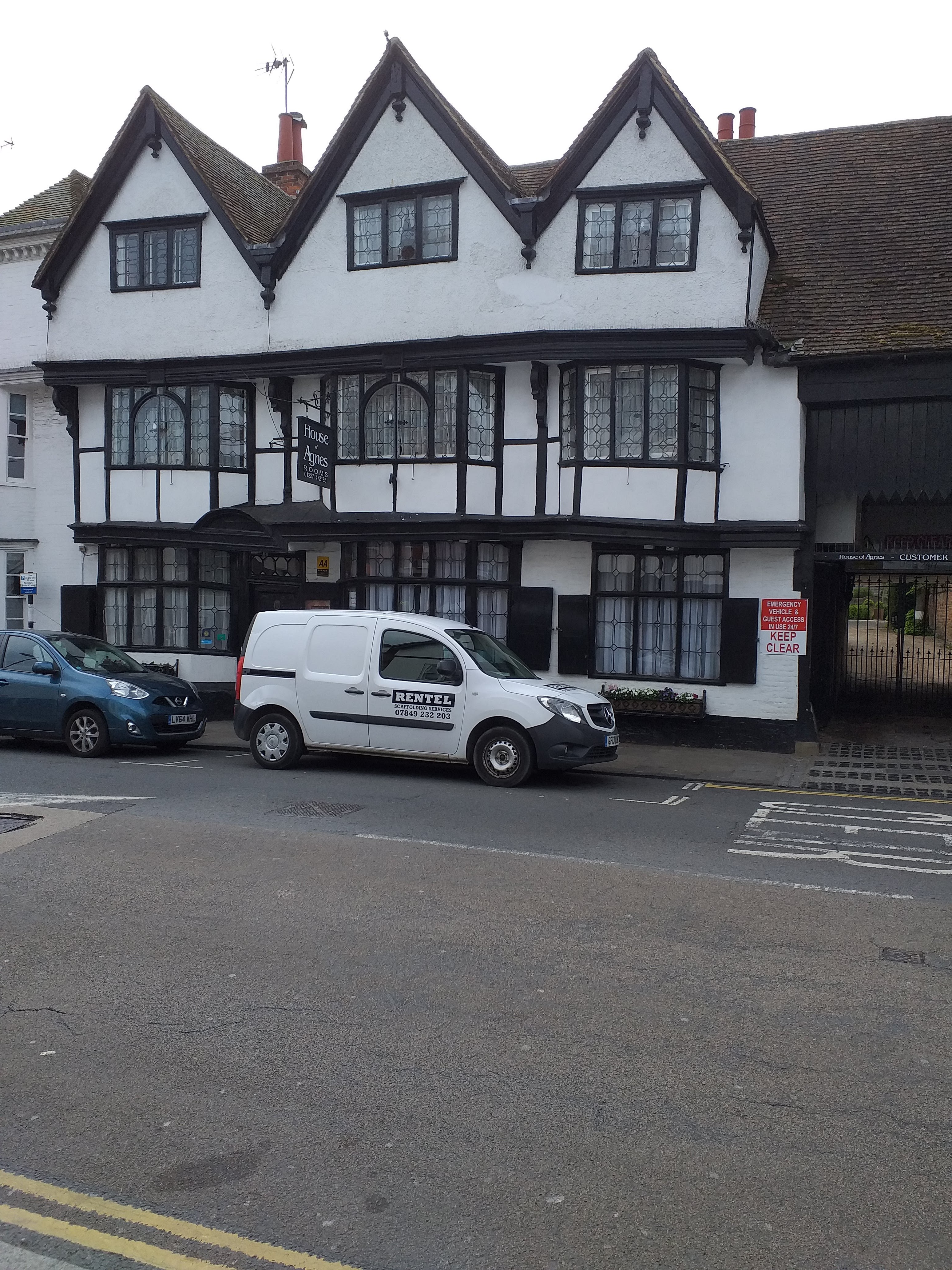
  • "At length we stopped before a very old house bulging out over the road; a house with long low lattice-windows bulging out still farther, and beams with carved heads on the ends bulging out too, so that I fancied the whole house was leaning forward, trying to see who was passing on the narrow pavement below. It was quite spotless in its cleanliness. The old-fashioned brass knocker on the low arched door, ornamented with carved garlands of fruit and flowers, twinkled like a star; the two stone steps descending to the door were as white as if they had been covered with fair linen; and all the angles and corners, and carvings and mouldings, and quaint little panes of glass, and quainter little windows, though as old as the hills, were as pure as any snow that ever fell upon the hills." (Ch 15): This house still exists in Canterbury; it is called the 'House of Agnes'.
  • "The neighbourhood was a dreary one at that time; as oppressive, sad, and solitary by night, as any about London. There were neither wharves nor houses on the melancholy waste of road near the great blank Prison. A sluggish ditch deposited its mud at the prison walls. Coarse grass and rank weeds straggled over all the marshy land in the vicinity. In one part, carcases of houses, inauspiciously begun and never finished, rotted away. In another, the ground was cumbered with rusty iron monsters of steam-boilers, wheels, cranks, pipes, furnaces, paddles, anchors, diving-bells, windmill-sails, and I know not what strange objects, accumulated by some speculator, and grovelling in the dust, underneath which—having sunk into the soil of their own weight in wet weather—they had the appearance of vainly trying to hide themselves. The clash and glare of sundry fiery Works upon the river-side, arose by night to disturb everything except the heavy and unbroken smoke that poured out of their chimneys. Slimy gaps and causeways, winding among old wooden piles, with a sickly substance clinging to the latter, like green hair, and the rags of last year’s handbills offering rewards for drowned men fluttering above high-water mark, led down through the ooze and slush to the ebb-tide. There was a story that one of the pits dug for the dead in the time of the Great Plague was hereabout; and a blighting influence seemed to have proceeded from it over the whole place. Or else it looked as if it had gradually decomposed into that nightmare condition, out of the overflowings of the polluted stream." (Ch 47)

Some of his immediate characterisations

  • "He was a limp, delicate-looking gentleman, I thought, with a good deal of nose, and a way of carrying his head on one side, as if it were a little too heavy for him." (Ch 6)
  • Uriah Heep, to be damned from the outset (all Ch 16)
    • His catchphrase: "I’m a very umble person." (False humility added to dropped aitches)
    • His behavioural quirks: 
      • "he frequently ground the palms against each other as if to squeeze them dry and warm, besides often wiping them, in a stealthy way, on his pocket-handkerchief"
      • "He had a way of writhing when he wanted to express enthusiasm, which was very ugly; and which diverted my attention from the compliment he had paid my relation, to the snaky twistings of his throat and body."

Selected quotes:

  • "The man with the wooden leg eyed me all over—it didn’t take long, for there was not much of me" (Ch 5)
  • "A cloggy sensation of the lukewarm fat of meat is upon me" (Ch 7)
  • "I used at first to wonder what comfort Traddles found in drawing skeletons; and for some time looked upon him as a sort of hermit, who reminded himself by those symbols of mortality that caning couldn’t last for ever. But I believe he only did it because they were easy, and didn’t want any features." (Ch 7)
  • "I was in the carrier’s cart when I heard her calling to me. I looked out, and she stood at the garden-gate alone, holding her baby up in her arms for me to see. It was cold still weather; and not a hair of her head, nor a fold of her dress, was stirred, as she looked intently at me, holding up her child. So I lost her." (Ch 8)
  • "I am conscious of having confounded it with those demoniacal parchments which are held to have, once upon a time, obtained to a great extent in Germany." (Ch 11)
  • "she was one of a series of protegees whom my aunt had taken into her service expressly to educate in a renouncement of mankind, and who had generally completed their abjuration by marrying the baker." (Ch 13)
  • "a grave building in a courtyard, with a learned air about it that seemed very well suited to the stray rooks and jackdaws who came down from the Cathedral towers to walk with a clerkly bearing on the grass-plot" (Ch 16)
  • "‘It was as true,’ said Mr. Barkis, ‘as turnips is. It was as true,’ said Mr. Barkis, nodding his nightcap, which was his only means of emphasis, ‘as taxes is. And nothing’s truer than them.’" (Ch 21)
  • "they had a weazen little baby, with a heavy head that it couldn’t hold up, and two weak staring eyes, with which it seemed to be always wondering why it had ever been born." (Ch 22)
  • "The whole building looked to me as if it were learning to swim; it conducted itself in such an unaccountable manner, when I tried to steady it." (Ch 24) (Being drunk, a delightful description)
  • "Miss Murdstone, like the pocket instrument called a life-preserver, was not so much designed for purposes of protection as of assault." (Ch 26)
  • "'I smoke, myself, for the asthma.' Mr. Omer had made room for me, and placed a chair. He now sat down again very much out of breath, gasping at his pipe as if it contained a supply of that necessary, without which he must perish." (Ch 30)
  • "Try not to associate bodily defects with mental, my good friend, except for a solid reason." (Ch 32)
  • "Frozen-out old gardeners in the flower-beds of the heart" (Ch 33)
  • "There’s an account about the people being hungry and discontented down in the North, but they are always being hungry and discontented somewhere." (Ch 36)
  • "To a man possessed of the higher imaginative powers, the objection to legal studies is the amount of detail which they involve." (Ch 39)
  • "they all seemed to treat Dora, in her degree, much as Dora treated Jip [her pet dog]in his." (Ch 41)
  • "From babies who had but a week or two of life behind them, to crooked old men and women who seemed to have but a week or two of life before them; and from ploughmen bodily carrying out soil of England on their boots, to smiths taking away samples of its soot and smoke upon their skins; every age and occupation appeared to be crammed into the narrow compass of the ‘tween decks." (Ch 57)
  • "what such people miscall their religion, is a vent for their bad humours and arrogance." (Ch 59)
  • "the prison ... was an immense and solid building, erected at a vast expense. I could not help thinking, as we approached the gate, what an uproar would have been made in the country, if any deluded man had proposed to spend one half the money it had cost, on the erection of an industrial school for the young, or a house of refuge for the deserving old." (Ch 61)

Rather too long; otherwise very entertaining with a huge cast of eccentric and memorable, but not very credible, characters.

July 2023; 991 pages


This review was written by

the author of Bally and Bro, Motherdarling 

and The Kids of God

Other works by Dickens, including those reviewed in this blog, can be found on this page.

Dickens: A Biography by Fred Kaplan


Thursday, 20 July 2023

"At Swim-Two-Birds" by Flann O'Brien


The key to unlock this labyrinthine but ultimately rewarding book is to realise that it is meta-fiction. In the very first paragraph, the narrator (a student, living with his disapproving uncle, a clerk at the Guinness Brewery in Dublin) discusses his “spare-time literary activities. One beginning and one ending for a book was a thing I did not agree with.” So he gives three beginnings (of course, there is a fourth beginning, because the book has already begun, with the narrator!):
  • About “Pooka MacPhellimey, a member of the devil class”.
  • About John Furriskey, the character in a book written, we will later learn, by Dermot Trellis, who is himself a character in stories told by the narrator.
  • About Finn Mac Cool, the “legendary hero of old Ireland”, a the subject of many stories, who will go on, after a lot of prevarication, to tell a story about mad King Sweeney.
The book ends with a discussion of madness, which seems appropriate, and the formula “good-bye, good-bye, good-bye”; so there are three endings to go with the three beginnings.

There are stories within stories. At one point we have a story about someone called Bartley being told by someone who is a character (Shanahan) in a story told by a character (Trellis) in a story told by a character (the student) in a story told by the author.

The characters take on a life of their own, interacting, and conspiring to drug the author so he sleeps so that they can live ‘normal’ lives without the author making them do things that they don’t want to do. And towards the end the characters decide to revenge themselves of the author so that one of them writes the story of Trellis being tortured and then put on trial by the characters; he only escapes when his maid, making up the fire in his bedroom, burns the manuscript pages that give life to the rebellious characters.

No wonder it’s confusing!

The narrative moves up and down the levels. It pokes fun of literary conventions (one character complains that although he has been provided with outer clothing he was given no underpants and therefore caught pneumonia; another character is born as a twenty-five year old man) and figures of speech (litotes, synecdoche, anadiplosis and anaphora). As a sort of homage to (or possibly satire on) James Joyce’s Ulysses, several literary styles and genres are used (including different sorts of poetry); the characters repeatedly prefer everyday styles (eg westerns are preferred to Irish myth, even though both may be about cattle rustling). There are foreshadowing and echoes; for example, Finn Mac Cool (a character written about by the student who is written about by the author), who is a figure from Irish myth, tells a story about mad King Sweeny who perches in trees and when Trellis is punished by his characters he is made to roost in a tree.

These foreshadowings and others are considered by Gallagher 1992 [Reflecting Mirrors in Flann O'Brien's "At Swim-Two-Birds" by Monique Gallagher in The Journal of Narrative Technique , Spring, 1992, Vol. 22, No. 2 (Spring, 1992), pp. 128-135 https://www.jstor.org/stable/30225357] as part of a profusion of mirrorings reminiscent of Bach or Escher; others Gallagher suggests are the indifference of the narrator as the pages of Trellis's manuscript are burnt, destroying his characters, reflecting the indifference of Nero as Rome burns; and the multiple duplications, including the joke that is repeated twice and the triple openings of both the student's story and Orlick's story.

It’s very clever and there are moments of beautiful writing. I particularly enjoyed the discussion between Furriskey, Lamont and Shanahan which was a sort of conversation through free association which ranged from death by drowning to Hemlock to Homer to the persecution of the Christians to blindness to harpists to blackheads and pimples and boils. You can hear these three Irishman in the pub, arguing and discussing and getting things wrong.

Another great set piece is when Shanahan recounts a story in the western genre, with all the vernacular, about he and his mates trying to reclaim rustled cattle and holding up a train etc. In the course of this story the cattle rustler at prayer is likened to Brian Boru who was the founder of the O’Brien dynasty (from whom Flann O’Brien had taken part of his pseudonym) and a King of Munster and subsequently High King of all Ireland, a warrior who died defeating the Vikings (who founded Dublin) at the Battle of Clontarf (a seaside resort north of Dublin whose name means ‘Meadow of the Bull’, where James Joyce lived when he was young); the resemblance seems appropriate because many of the exploits of legendary Irish heroes seem to have been glorified cattle rustling.

There are so many in-jokes. Two characters who appear are called “Timothy Danaos and Dona Ferentes” (Timeo Danaos et dona ferentes = “I fear the Greeks even when bearing gifts” is a famous line from the Aeneid). There is a wonderfully bad-tempered Good Fairy.

From time to time the frame story intrudes in which the student (who lives with his somewhat censorious uncle) lies in bed, goes to college, goes to the pub and gets drunk, is violently ill, and then goes back home to lie in bed again.

There’s part of me that wants to know what it all means. Great literature, I tell myself, should have a purpose. But does it ever? Is there a purpose for Ulysses? Presumably the work of Wodehouse is intended to make people laugh, to entertain. Is At Swim-Two-Birds no more than a prolonged joke? What is the point of it?

McMullen 1993 [Culture as Colloquy: Flann O'Brien's Postmodern Dialogue with Irish Tradition by Kim McMullen in NOVEL: A Forum on Fiction , Autumn, 1993, Vol. 27, No. 1 (Autumn, 1993), pp.
62-84 https://www.jstor.org/stable/1345981] points out that O'Brien was a member of the first generation that reached adulthood in the new Irish Free State and that the establishment of the time was trying to revivie the Irish language as part of a programme to redefine an Irish identity. McMullen argues that O'Brien was reacting against the monocular vision of Irishness promoted by the Roman Catholic church and other conservatives ideologies by showing that a language is an conglomeration of different influences; hence his incorporation of a variety of texts, from a racing tipster to early Irish epics, from mediaeval nature poetry to the pub jungles of the Workingman's Poet, and that "none of these discourses is privileged; none has the last word". 

Swim-Two-Birds is the rough translation of an Irish placename where there is a church which mad King Sweeny reportedly visited. I'm not sure whether that explains the title of the book.

The selected quotes include some wonderful observations of human behaviour, moments of original and beautiful description

Selected quotes:
There are no chapters so I have used page references for the 1967 Penguin Modern Classics edition.
  • "I know the studying you do in your bedroom, said my uncle. Damn the studying you do in your bedroom." (p 11)
  • "I am fond of wing-beating in dark belfries, cow-cries in pregnancy, trout-spurt in a lake-top. Also the whining of small otters in nettle-beds at evening, the croaking of small-jays behind a wall, these are heart-pleasing." (p 14)
  • "The chest to him was ... pastured from chin to navel with meadows of black man-hair and meated with layers of fine man-meat." (p 14)
  • "The mind may be impaired with alcohol, I mused, but withal it may be pleasantly impaired." (p 22)
  • "On we slithered with as much sound out if us as an eel in a barrel of tripes." (p 56)
  • "Shut the door, said Shanahan, but see you're in the room before you do so." (p 62)
  • "He swallowed a draught of vesper-milk, restoring the cloudy glass swiftly to his knee and collecting little belated flavourings from the corners of his mouth." (p 72)
  • "His laugh had a dual function, partly to applaud his jest, partly to cloak his anger." (p 93)
  • "The idea that all spirits are accomplished instrumentalists is a popular fallacy, said the Good Fairy in a cold voice, just as it is wrong to assume that they all have golden tempers." (p 116)
  • "Give the word, said Shorty with a waving menace of his hand, or it's gunplay and gravestones." (p 118)
  • "He was as blind as the back of your neck." (p 156)
  • "You can steam your face till your snot melts but damn the good it will do to your blackheads if you don't attend to your inside." (p 157)
  • "Be damned but he wouldn't die. I'll live, says he, I'll live if it kills me, says he." (p 158)
  • "To say which of them is worst, that would require a winter in a web of thought." (p 175)
  • "To fly ... towards the east to discover the seam between night and day, that is an aesthetic delight" (p 180)
  • "The gift of flight without the sister-art of landing ... is always a doubt." (p 180)

Similar works reviewed in this blog include:

Flann O'Brien also wrote The Third Policeman

Other books by Irish authors reviewed in this blog are on this page.

July 2023; 218 pages

Robert McCrum rated this 64th on The Guardian's 100 best novels of all time. Time magazine selected it as one of the 100 best novels since Time began. Anthony Burgess chose it as one of his 99 best novels since 1939.


This review was written by

the author of Bally and Bro, Motherdarling 

and The Kids of God


Wednesday, 19 July 2023

"Germania" by Simon Winder

 A delightful history of Germany (and Austria) from Roman times until 1933, covering the patchwork Holy Roman Empire, the Hapsburgs, the Thirty Years War, the Napoleonic wars, the unification of Germany under Bismarck, and the horrors of the First World War and its aftermath. It is organised, roughly, in chronological order but the author cannot help wandering off on diversions, particularly focusing on his holiday travels as he compiles this book, taking us to so many tiny little towns that were once capitals of princely microstates, expressing all the horrors of yet another provincial museum (he is simultaneously fascinated and bored stiff by exhibits - aren't we all? - and horrified by some of the naff artworks -aren't we all?), and discoursing inter alia on the food, the culture and the beer. The whole experience creates perhaps the most entertaining (at times downright hilarious) and irreverent history book I have ever read. 

And I learned that Captain von Trapp (of Sound of Music fame) was a prominent member of the international expeditionary force that destroyed the Boxer Rebellion! And the 5,4,3,2,1, blast-off sequence comes from a film by Fritz Lang made in 1929 which entranced the young Wernher von Braun.

Selected quotes:

  • "for some, travel is a chance to admire the Counter-Reformation altarpieces and for others a chance for a one-on-one roughhouse with a Dortmund transsexual ... they could intersect in some of the less bustling regional museums." (Introduction)
  • "It is an odd feature of so many holidays that they are structured around having far worse facilities for cooking and cleaning than at home." (Introduction)
  • "Like some acne-laden Kentish Goethe, I had arrived." (Introduction)
  • "There is no escaping the ugly stupidity of this room, the misguided twenty-year labour of an almost pulselessly untalented Dresden painter." (Ch 1)
  • "I found myself irritably wondering why genial but essentially pointless little birds like bullfinches could bomb around in the fir trees surviving the winter whereas I would be dead of exposure within twenty-four hours." (Ch 2)
  • "Louis IX of France wandering about in a swamp in the Nile Delta, carried in a litter by four strong men with a special hole cut in the seat to allow his dysentery to freely and immediately express itself." (Ch 2)
  • "Some fifteen million years ago, when Germany was a balmy, sub-tropical place filled with the grunts and whistles of proto-elephants and giant turtles, a nearly mile-wide asteroid smashed into Nordlingen (or at least its future site), making a crater some fifteen miles wide and having an impact comparable to an inconceivable 1.8 million Hiroshimas." (Ch 7)
  • "German art has always loved corpses, guttering candles, emblems of human folly, dances of death." (Ch 8)
  • "The more panoramic the view the worse the food." (Ch 8)
  • "But the sheer absurdity of his court, with everyone watching the king shitting or admiring his ballet moves ... or sitting around watching pageants ... did really nobody laugh?" (Ch 8)
  • "Apart from Rome, Mainz was the only town that could be referred to as 'the Holy See'." (Ch 8)
  • "It would be a gloomy pedant who did not revel in The Scarlet Empress and admit that watching Dietrich dressed in a sort of satellite dish covered in pompoms eyeing up her strapping troopers brings history to life." (Ch 9)
  • "A side chapel: the piece of resistance" (Ch 9) Yes!!!! Why not translate the overwhelmingly pompous piece de resistance?
  • "Germany really is covered with ivy-covered turrets and the promise of solitude (Kepler staring at the planets above Prague, Faust conjuring demons) - the great majority presumably built in the nineteenth century in response to the whole literature devoted to the subject." (Ch 10)
  • "Nationalism is one of the most confusing subjects of the nineteenth century, with the added bonus of becoming worse and worse the more anyone thinks about it." (Ch 11)
  • "The little-known but enjoyably named Prussian Mouthful [schnapps] ...tastes like something that might be used to clean rust from girders and can be recommended to nobody." (Ch 12)
  • "I have never found mountains particularly interesting ... it might be a more intelligent use of life to have ... stayed in the attractive hotel with a book and a few drinks." (Ch 12)
  • "California began as a fictional country" (Ch 12) It first appears around 1510 in a popular Spanish novel by Garci Rodríguez de Montalvo (aka Ordóñez de Montalvo) called  The Adventures of Esplandián in which it is an island populated only by black warrior women.
  • "The hidden trajectory of heroism which ends so many once glamorous careers: as a seedy, burned-out Robin Hood, in a prolix, cadging and elderly Hannibal." (Ch 12)
  • "This strange formula that allowed the takeover of other people's land to be followed by speechless outrage when those people had the gall to resist, is a phenomenon not sufficiently thought through." (Ch 13)
  • "Essentially the First World War did not earn that name because of Germany or Austria-Hungary, who could hardly move out of their small chunk of Central Europe, but because of the Allies, who ruled most of the world." (Ch 14)

A superbly eclectic and irreverent history. Great fun. July 2023; 441 pages


This review was written by

the author of Bally and Bro, Motherdarling 

and The Kids of God


Thursday, 13 July 2023

"The Malta Exchange" by Steve Berry

Preposterous hokum.

 A boys'-own thriller with a typically too-good-to-be-true hero: Cotton Malone, who has starred in at least a dozen other novels, all with three word titles starting with 'The'. He is "fluent in Italian  and several other languages, one of the benefits of having an eidetic memory" (Ch 4) He enjoys ostentatious display, renting an Alfa Romeo "since who didn't like driving a 237-horsepowered engine that could go from zero to sixty in four seconds" (Ch 1) and staying at a penthouse suite in one of Rome's finest hotels (Ch 16), presumably on the grounds that no-one would believe that a spy would make himself so visible. 

Fortunately, there is another hero, Luke, who is delightfully accident prone and survives scrape after scrape. The utter improbability of this strained my suspension of disbelief to the limit.

There was a lot of action, with different people killing other different people, for reasons I neither understood nor cared about.

The plot was very 'da Vinci code'. Various parties are trying to get their hands on a long lost manuscript which contains a secret which, if revealed, will rock the Roman Catholic church to its core. Of course, once the secret is revealed, there is a sense of 'so what?' The hugely improbable manuscript reveals a secret that most people probably wouldn't even read a newspaper article about, let alone kill or die for. 

I also never really understood why the interested parties, all of whom knew a lot more about the manuscript, had to recruit American Intelligence to help them crack a series of really rather silly clues. Especially as one of the clues involved word play which works in English but was in a message written, we are told, in German and, so far as I can find, the word play wouldn't work in German. Looks like a plot flaw to me. Though, tbh, I don't really care.

As for the characters, they were the usual paper-thin thriller types. 

The chapters are very short: the first 15 chapters average six pages each. 

In much of the text, Berry follows a long paragraph with a very short paragraph, usually a single sentence or sentence fragment, rarely more than a few words long. For example:

The most secret agency within the Holy See had existed since the 16th century, created specifically by Pius V to end the life of the Protestant Elizabeth I and support her cousin, the Catholic Mary, Queen of Scots, for the English throne.  Though it failed in that mission, ever since it had served popes through schisms, revolutions, dictators, persecutions, attacks, world wars, even assassination attempts. First called the Supreme Congregation for the Holy Inquisition of Heretical Error, then the much shorter Holy Alliance. In the 20th century it was changed to the Entity.

Its motto?

With the Cross and the Sword.

Frequently, this technique is used to impart information (the author has done a lot of research into the Knights of St John, Mussolini, and the Roman Catholic church) in the long paragraphs and then comment upon that in the ensuing one or two sentence fragments. There is an awful lot of the book written in this style.

Selected quotes:

  • "If flying was so safe, why'd they call the airport a terminal?" (Ch 4)
  • "War doesn't determine who's right, only who's left." (Ch 5)
  • "Husbands are like cars. They're all good the first year." (Ch 8)
  • "His main source of exercise was pushing his luck." (Ch 14)
  • "The pessimist might be right in the long run, but ... the optimist had a better time along the way." (Ch 19)

I shan't be wasting my time reading anything more by this author.

July 2023; 393 pages


This review was written by

the author of Bally and Bro, Motherdarling 

and The Kids of God