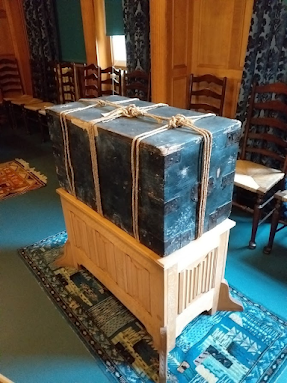
Shortly after the First World War, Mabel Barltrop, the widow of a vicar, who had already spent two periods in lunatic asylums because of her mental illness, discovered the writings of eighteenth century prophetess Joanna Southcott. She set up the Panacea Society in Albany Road in Bedford, UK. Quickly, the Society decided that Mabel was Octavia, daughter of God, and that Bedford was the site of the Garden of Eden. Octavia spoke with God every evening and passed on God's messages at the Society's evening worship. Another member who went into trances began to speak as the Divine Mother and it was discovered that Mabel's dead husband had been Jesus, come back to Earth. The practices of the community involved confessing one's sins (this gave the Divine Mother a significant psychological hold over members), and 'overcoming' the self; the reward was literal immortality. Octavia began to breath on small squares of linen. When these were infused in water, the water could heal every disease (hence Panacea) and water sprinkled around a building would protect it, even from bomb damage. The community grew to house seventy resident members, more who were 'sealed' (who would form the nucleus of the 144,000 who would survive the end of times) and the linen squares were requested by over 130,000 people world wide (especially in countries where healthcare was expensive). It survived the death of many members (so much for immortality) including Octavia herself, but has probably died out now. Nevertheless, the buildings still remain, including Octavia's own house where her bedroom is preserved for the return of her body (from Uranus), the Ark which has a cradle ready for the return of Jesus himself, and Castleside (which was once a Bedford School boarding house) which was fitted out so that the 24 Bishops of the Church of England could gather for the opening of Joanna Southcott's sealed Box of prophecies.
Incredible nonsense! It is difficult to understand how so many people could be so needy and gullible as to believe such rubbish and to submit themselves to total obedience to a pair of women who were either mad or charlatans.
This book focuses on the activities of the Society in its heyday, from origination to the death of Octavia. Even in this short time (1919 - 1934) a lot happened. Some of it is rather tedious: lengthy theological disputes motivated essentially by Octavia's right wing politics and Edwardian snobbishness. Some of it is racy: the introduction of Edgar Peissart in 1922 led to the development of a gay sex ring amongst some of the male resident members (in a community devoted to chastity); when this was discovered and one member of the community was forced to kneel and confess he noticed a knife and "thought he was about to be sacrificed"! The community also tried to persuade non-resident members (usually post-menopausal women) to give up 'sex-relations'.
There are some very sad stories. Dilys, Octavia's daughter, tried to break away but ended up, after some periods of mental illness, living, unmarried, in the community for the rest of her life, often lonely because most of the residents were older women. Poor people were only allowed to become residents if they worked for the community, usually as exploited domestic servants. Olivia's two surviving boys kept as far away from Bedford as possible, mostly living abroad, embarrassed by their mother and her claim that they were the sons of Jesus. And there is a sense of sadness about the whole thing: most of the residents were lonely or vulnerable in some way.
The book was compelling to me because I live in Bedford, a few streets away from The Ark, and Castleside, and the other Panacea properties. The idea that Bedford might be the New Jerusalem is both bizarre and (given the millennia of strife over the old Jerusalem) scary. The idea that people might imbue everyday ordinary Bedford with such daft beliefs is staggeringly weird.
In the end, I don't think I really understood why anybody believed in Octavia (let alone the Divine Mother!) They were promised immortality of the body but people still died. If they were old and lonely the community was a sort of rest home. But they were expected to give up very natural human things like sex and to deny themselves and to be totally obedient to two women whom they lived with everyday. Charisma can only take you so far. I just cannot imagine accepting some of these outlandish beliefs: Mabel is a prophetess, her dead husband was Jesus, Bedford is the Garden of Eden, Jesus will return to Earth here.
A usually interesting read. March 2015; 334 pages