Friday, 23 February 2024

"The Council of Justice" by Edgar Wallace

 This is the sequel to Wallace's debut novel, The Four Just Men, starring three of the original quartet (Manfred, Gonsalez and Poiccart) who recruit a fourth whose alias is Courtlander. The FJM are vigilantes dedicated to murdering those who are getting away with criminal activities (a bit like the eponymous hero of the Saint books by Leslie Charteris).  In this novel they are up against the Red Hundred, an anarchist group. Various adventures ensue while Scotland Yard looks on helplessly. Finally, justice having been meted out and a proposed assassination averted, Manfred is captured while meeting his arch-rival and potential love interest The Woman of Gratz. He is tried for murder and convicted. Can he escape the hangman's noose? 

It is a naive thriller relying on expert chemists creating swift-acting poisons and wonderful explosives, me who are masters of disguise, fluent in many languages, rich and well-supplied with information from a huge range of naturally impeccable sources. Modern readers are usually too sophisticated to suspend their disbelief so easily. But it does give wonderful insights into London in the year before the First World Wars, a place well used to terrorist 'outrages' (through bombs being dropped from Zeppelins were a little premature), a country where anarchists held their conferences and everyone had access to a revolver. 

Told in mostly simple language, in short chapters, with a very direct style in which 'tell' is often privileged over 'show', this is very easy to read. With the exception, perhaps, of the Woman of Gratz, the characters are one-dimensional and clearly divided into goodies and baddies, despite the moral ambiguity of making vigilante outlaws the heroes. (But on the other hand, what else is the classic English folk hero Robin Hood?) There is an even-handedness in making both heroes and villains exotic foreigners which was rarely emulated in contemporary and subsequent alternatives, such as Sexton Blake and James Bond where the English goody commonly battles baddies from abroad. The fundamental motivation for continuing to read is not to find out whether the heroes will eventually triumph but to solve the convoluted puzzle of how they will achieve their aims. The focus is therefore on why a huge hole has appeared in the building in which two bodies are found, why a strange house has been constructed in the Spanish countryside, and how Manfred will effect his escape?

Selected Quotes:

  • "There are no straight roads, and you cannot judge where lies your destination by the direction the first line of path takes." (Ch 2)
  • "His liabilities were of no account because the necessity for discharging them never occurred to him." (Ch 5)
  • "Eden in sight - he pleaded for an Eve." (Ch 6)
  • "He was as close ... as the inside washer of a vacuum pump." (Ch 7)
  • "Possessed of the indifference to public opinion which is equally the equipment of your fool and your truly great man." (Ch 9)
  • "The sons of fathers who were the sons of fathers who had some time ruled by might, and left the legacy of their dominion to their haphazard progeny." (Ch 10) Wallace is clearly in thrall to aristocrats and royals and great men, perhaps because of, perhaps in spite of, his own humble and confused beginnings ... but he could see the other side of the argument.
  • "If in England you race a horse and it wins your Derby, must the stock of that horse be acclaimed winners of the race from birth?" (Ch 10) It's a good argument against a hereditary monarchy!
  • "Spoken like a cheap little magazine detective." (Ch 18)

NB: An electrolier is a chandelier in which the lights are electrical (rather than candles).

One of the classic progenitors of thriller fiction. 

February 2024; 310 pages



This review was written by

the author of Bally and Bro, Motherdarling 

and The Kids of God


Tuesday, 20 February 2024

"The Satyricon" by Petronius (?)

 The Satyricon is composed of fragments from a much longer Latin work which most scholars think was written by Petronius. It is written in both prose and poetry and seems to be based on the Odyssey, being a comic picaresque following the adventures of a runaway slave called Encolpius (the narrator), his boyfriend young Giton, and his friend (and rival for Giton's affections) Asclytus

Much of the work is lost. The first (incomplete) remaining section seems to be an account of the punishment of Encolpius and Asclytus for having (inadevertently?) seen the secret female rites of Priapus: they are tied up and buggered by a male prostitute. 

The second, and most famous, section involves a dinner hosted by a freed ex-slave turned millionaire called Trimalchio (which includes a story about a man turning into a werewolf). Trimalchio has been seen as the model for Jay Gatsby in The Great Gatsby. This section also influenced Oscar Wilde in The Picture of Dorian Gray. 

They then fall in with a windbag of a poet called Eumolpus and board a boat which they then discover is owned by the slave-owners they are running from; shipwreck is the deus ex machina which gets them out of a very tight situation. 

They then travel to a place called Croton.

It is difficult to judge the literary merit of a work that only exists in fragments. I suspect that much of its fame rests on the fact that the narrator is joyfully gay.

Selected quotes:

  • "An adolescent taste is quite worthless." (Puteoli 4)
  • "I personally went colder than a winter in Gaul." (Puteoli 19)
  • "He pulled the cheeks of our bottoms apart and banged us" (Puteoli 21)
  • "So the starry sky turns round like a millstone, always bringing some trouble, and men being born or dying." (Dinner with Trimalchio 39)
  • "It's night 'fore y'can turn around. So the best thing's get out of bed and go straight to dinner."  (Dinner with Trimalchio 41)
  • "A hot drink's as good as an overcoat."  (Dinner with Trimalchio 41)
  • "If you were somewhere else, you'd be talking about the pigs walking round ready-roasted back here."  (Dinner with Trimalchio 45) A version of 'the grass is always greener'

February 2024; 123 pages


This review was written by

the author of Bally and Bro, Motherdarling 

and The Kids of God


Friday, 16 February 2024

"Tennis Lessons" by Susannah Dickey


A book narrated in the second person which is an incredibly unusual thing to do.

It is, I suppose, a bildungsroman, a coming-of-age novel. 'Your' story starts at three years old and progresses to twenty-eight. 'Yours' is a very ordinary life in a normal house in a normal town, you go to a normal school. You're a bit of an ugly duckling but you are clever and quick-witted. Unfortunately, perhaps because you are bullied for being 'weird', this doesn't translate to academic success at school. The first part of the novel takes you to the threshold of your school-leaving exams in a series of snapshots taken through the years. The second part of the book recounts some traumatic events at the time of the exams and their consequences. The third part returns to the snapshot format and considers the fall-out.

It was well-written and viscerally rooted in ugly everyday reality. No murders, no superheroes, no death-defying struggles, no grand adventures. Just ordinary life. But there was drama, there was tension, there were challenges to be overcome, there were little triumphs, there were larger disasters, there was even, of a sort, love. This makes it as weird but as honest and as truthful as its protagonist, who says: "You wish your class could read books about something other than war and the children of war; you want to read about normal people trying to do normal things." (Part One: 13 years old - May) The wish has here been granted.

Selected quotes:

  • "Your stomach yodels with hunger." (Part One: 11 years old - February 11th)
  • "You wonder if she likes her life, or if she, like you, is dependent on the idea that things will improve." (Part One: 17 years old - December)
  • "The thought of going makes you anxious. The thought of not going makes you anxious." (Part Two: 17 years old - May 16th today)
  • "You imagine it's much easier to endure unhappiness if you have a child who is beautiful and clever and loved. What have you been worth?" (Part Two: 17 years old - May 16th today)
  • "When you get closer you realize it's a dead kitten. Its legs are curled up into its torso and its head is pressed to its chest. It looks like an asterisk and a closed parenthesis; a bass clef; the curved end of a hockey stick." (Part Two: 17 years old - May 16th today)
  • "It's a bit like talking to someone who's wearing a space helmet, like everything you say to her is muffled and there's a time delay in her response." (Part Three: 22 years old - March)
  • "A Sunday carvery approach to religion" (Part Three: 24 years old - December) It means an approach to religion that just selects which bits the believer wants to follow eg abortion bad, adultery yes please.
  • "Sprinkle the salt of your dreams on the slugs of your enemies." (Part Three: 27 years old - November)
  • "Perhaps living contentedly is just finding pursuits that distract you from thoughts of oblivion. It occurs to you that everyone else probably figured this out long ago." (Part Three: 28 years old - August)
A book full of the troubles of growing up. Well worth a read.

February 2024; 240 pages


This review was written by

the author of Bally and Bro, Motherdarling 

and The Kids of God

Wednesday, 14 February 2024

"No Dumping Allowed" by L M Ford


"Amanda Danvers stared at the arm sticking out from behind the dumpster" is a great first line which hooked my attention straight away. We are instantly launched into a murder mystery set in a small town in the USA. Amanda, the new owner of a car-wash business where the body has been dumped, investigates whodunnit. Needless to say, she succeeds where the cops fail, unravelling the mystery despite a number of red herrings. 

It is targeted at 12 - 18 years and there are many aspects of this novel which make it suitable, particularly for readers at the younger end of the age range:
  • It is very easy to read. The author has a direct style which focuses on the plot, stripping away unnecessary sentences. I would have liked a  little more description to help me better visualise what was going on and I suspect some of the older teenagers would have enjoyed more gore but the author is probably wise to avoid too much detail.
  • It is almost inevitable for a murder mystery to have a large cast of characters: suspects, witnesses and the detective and her friends and helpers. Given that the book was deliberately designed to be short, some of these characters were necessarily underused. I would have loved to have more of the golf-playing coroner, for instance. But each of the main characters was distinctive and I never confused them. I suspect that this book is the first of a series; I hope we meet some of the characters again.
  • The heroine is clearly an adult and I wondered how easy it would be for some of the younger readers to identify with her. There is a romantic element to the plot but it doesn't progress beyond kissing. Again, older readers might see this as too tame but it seemed appropriate to me.
  • There are a couple of scary situations. I would have liked more of a sense of threat but there is a delicate balance to be struck between increasing the tension and scaring the younger readers.
  • There were dead ends and in a longer novel there might have been the scope for progressing further down these. Similarly, the size of the book seems to have precluded the classic 'extra twist'.
I found the simplicity of the narration refreshing.

I think my favourite moment came in chapter one when Amanda is pondering how to write a commiserative social media post about the death; among other great lines she rejects are: 

  • You can’t wash away bad karma, even at a carwash. 
  • Real estate developer ends up with only ten inches of land behind a dumpster. 
  • Carwash owner issues reminder: dumping is illegal and so is murder.

My next favourite quote was:

  • "Maybe she was just spinning her wheels, but they were her wheels and [she] had a right to spin them if she wanted." (Ch 8)

An unpretentious and straightforward murder mystery.

February 2024


This review was written by

the author of Bally and Bro, Motherdarling 

and The Kids of God


Tuesday, 13 February 2024

"Boulder" by Eva Baltasar


 Astonishing prose.

A cook on a cargo ship in South America falls in love with a Scandinavian; they begin a lesbian relationship, move to Iceland, settle down in a house and have a daughter. But can a free spirit be tied down in domesticity?

Astonishing prose. Or is it poetry? This author (and translator, Julia Sanches) makes magic out of words. Don't read this for the plot though it is strong but simple. Do not read this for the characters though both the major characters, the unnamed narrator-protagonist and her partner-antagonist are true to life, springing from the page in all their complicated three-dimensionality. Don't read it for the insights that it offers into life, though these are well-observed and original. Read it for the wonder of the words.

Selected quotes (to show you what I mean): 

  • "A night years ago. Sometime after ten. No sky, no vegetation, no ocean. Only the wind, the hand that grabs at everything." (Ch 1)
  • "The cold feels peculiar. It's possible I've drunk some of it myself, since I can feel it thrashing and bucking under my skin, and also deeper inside, in the arches between each organ." (Ch 1)
  • "Stained teeth bared in greeting." (Ch 1)
  • "Water, earth, lungs. The perfect conditions for silence." (Ch 1)
  • "Food comes to us wrapped in skin, and to prepare it you need a knife." (Ch 1)
  • "The islanders rise. They look like enormous turtles hatched from a large egg. They plod through the rain, and as the pass me I feel like an insignificant foreigner, disease-white and sopping wet under my dark blue rain jacket. You'd need two of me to make one body as tough as theirs." (Ch 1)
  • "I don't fuck her, I whet myself on her. I drink her like I'd been raised wandering the desert. I swallow her as if she were a sword, little by little and with enormous care. The hours layer over one another, blanketing us." (Ch 1)
  • "These new, single-family homes have ravenous souls that feed off your own little human soul - sucking dry your freedom, your independence, and all trace of your passion." (Ch 2)
  • "The house gathers itself up and looms over you. It unhinges its jaw like those terrifying snakes that bleed the milk from sleeping mothers then curl up like necklaces against their skin." (Ch 2) A foreshadowing of motherhood?
  • "I'm not into kids. I find them annoying. They're unpredictable variables that come crashing into my coastal shelf with the gale force of their natural madness. They're craggy, out of control, scattered." (Ch 2)
  • "The truth is we'd never made any plans, we'd just taken huge bites out of life." (Ch 2)
  • "The sofa is a place for sitting and talking, a sensible piece of furniture designed to promote verticality and position the head as the sovereign supreme of all the subordinate organs, including the heart." (Ch 2)
  • "The hormones are doing their job, they season and marinate her body, manipulating it to cater to the baby's taste and satisfaction." (Ch 2)
  • "Time has set its sights on us and slowly worn us down, sharpening its teeth on our bodies." (Ch 2)
  • "If you could only set fire to every word that evokes an illness." (Ch 3)
  • "I'm sick of the extrasensory powers that biology confers upon its devotees." (Ch 4)
  • "Personality is a dress made of scraps that I never stop washing or mending; it clothes me, might even suit me, but it will never, ever define me. The nakedness I conceal is what makes me a person." (Ch 5)

Boulder won an English Pen Translates award in  2021. It was shortlisted for the International Booker Prize in 2023. 

February 2024; 105 pages


This review was written by

the author of Bally and Bro, Motherdarling 

and The Kids of God


Sunday, 11 February 2024

"Offshore" by Penelope Fitzgerald


Winner of the Booker Prize in 1979.

An exploration of the liminal lives of a group of houseboat owners on Battersea Reach in the tidal Thames in the early 1960s, as Swinging London gets underway. Richard, retired from the Royal Navy, lives with his wife (who longs for a normal house) on a converted minesweeper. Maurice lives on his own on a dutch barge and most nights he brings home a customers from the local pub; his boat is also used by Harry to store stolen goods. Willis, a 65 year-old artist, is trying to sell his leaky boat before it sinks. Nenna's boat is home to herself and her two daughters, 12 and 6; her hopeless husband can't bear living abroad and has left her to cope alone. Woodie and Mrs Woodie are an elderly couple who support the others through the various crises.

The constant reference to leaks, to the need for continual maintenance, and the rats, certainly put paid to any romantic notions I might have had about living on a boat.

The book refers several times to "the short uneasy period between land and water" (Ch 7) and the characters do seem to be living in a kind of limbo. The epigraph is taken from Dante and there is a reference to the river that souls must cross to enter the classical underworld: "Rat-ridden and neglected, it was a wharf still. The river's edge, where Virgil's ghosts held out their arms in longing for the farther shore, and Dante, as a living man, was refused passage by the ferryman ... there, surely, is a place to stop and reflect." (Ch 1) There are a lot of endings, from the three drowned sailors seen by little Tilda, to a sinking ship, to the death of a marriage, to an attempted murder. All the characters seem to be betwixt and between, living lives of transience, and those who live on land in proper houses, such as the priest, disapprove. I suspect that the author is saying that life itself is impermanent and that places that remind us of this are indeed places to "stop and reflect". 

This feeling of liminality is reflected in the chronology. The book seems to be set in late 1961 (the spring of 1962 is said to be in 6 months time and Nenna married in 1949 and her eldest child in 12) but Heinrich wants to see "Swinging London" which is generally agreed to have started in 1964. This anachronism seems appropriate when you live on the threshold. And Nenna is asked (in an imaginary court trial), "'Look here, is it Wednesday or Thursday?' 'I don't know, Ed, whichever you like'." (Ch 3). Time is unimportant in a liminal space. Again, in chapter 5, the author describes the old mother of Willis as "perdurable" which means imperishable but later in the sentence we discover that the woman has died of cancer; this seems to be a deliberate oxymoron.

It is, however, paced just like a classic novel: the key turning point comes almost exactly in the centre of the book.

 Have I ever mentioned how much I hate it when authors write in a foreign language? This novel's epigraph (that's the quotation at the start to you and me) is "che mena il vento, e che batte la pioggia/ e che s'incontran con si aspre lingue" which are two lines of mediaeval Tuscan taken from Dante's Inferno (canto 11) which mean "those whom the wind drives, and those whom the rain batters, and those who encounter one another with such bitter words." 

Selected Quotes:

  • "Duty is what no-one else will do at the moment." (Ch 1)
  • "It's not the kind who inherit the earth, it's the poor, the humble, and the meek. ... the kind ... get kicked in the teeth." (Ch 6)
  • "It was like one of those terrible sights of the racecourse or the battle field where wallowing living beings persevere dumbly in their duty although mutilated beyond repair." (Ch 7)
  • "It's my last chance. While I've still got it I can take it out and look at it and know I still have it. If that goes, I've nothing left to try." (Ch 7)
  • "I can't for the life of me see why, if you really feel something, it's got to be talked about." (Ch 8)
  • "He disliked comparisons, because they made you think about more than one thing at a time." (Ch 8)
  • "All distances are the same to those who don't meet." (Ch 10)
  • "The James family seemed to have few possessions. Mrs Woodie felt half inclined to lend her some, so as to have more to sort out and put away." (Ch 10)

The plot might be minimal but this is a book of beautifully drawn characters in a very special world.

February 2024; 181 pages


This review was written by

the author of Bally and Bro, Motherdarling 

and The Kids of God

Friday, 9 February 2024

"The Wren, The Wren" by Anne Enright

The Shelbourne hotel Dublin is mentioned in the novel

 The story consists of periods, shuffled chronologically, in the lives of three members of an Irish family. Each has their chance to narrate. Phil, the grandfather was a poet; he remembers his boyhood in the country. Carmel, one of his daughters, ran, or perhaps runs, a language school and brought up her daughter, Nell, as a single parent. Nell is a freelance writer, working for influencers and producing work to market, for example, travel destinations. No-one seems to need to work very hard in order to earn a decent living and, in Nell's case, travel the world but we're not focusing on their economic activity. Rather, the book targets their sex lives.

Phil believes that all poetry is about unrequited love, and that all love is unrequited. He deserts his wife and daughters to travel and marry an American; he probably had multiple affairs as well. Carmel has divorced sex and relationships; the only real loves in her life are her Dadda and her daughter and she abandons a potential partner when it becomes clear that he might expect her to look after him. Nell is trapped in a physically abusive relationship with a man who is clearly seeing other women but whom she is in love with. 

Men certainly don't come out of this well. Most of them are portrayed as violent. The nice ones are needy but they all (except the gay one) expect to be looked after and serviced. And yet Phil the poet seems irresistible to women, Nell can't leave the man who hits her because she loves him. So why can't the women treat the men as potential sperm donors and live without them? Perhaps because, as Mal, the gay friend in Utrecht, tells Nell: "The thing women don't understand is that love and sex are opposite things ... Love requires ... two acts of submission, and sex ... really doesn't." (p 201)

But the joy in this book doesn't lie in its characters, strong though they are, nor in its fragmented and meandering plot, nor in its exploration of the issue of domestic violence, but in its words. The narratives are separated by Phil's poetry, and I don't really understand poetry, but scattered throughout are phrases and sentences of pure gold. Some are descriptive, some are nuggets of wisdom, 

Selected quotes: page references are from the 2023 Jonathan Cape hardback edition

Funny moments:

  • "I was making my way out in the big bad world, and for some reason this involved a lot of staying in." (p 10)
  • "The Hoover sat gathering its own dust at the top of the stairs." (p 60) 

Perfectly captured descriptions:

  • "I stayed over, waking in the morning to the sight of him asleep, his lips easy and full, the air slipping into his body and slipping out again." (p 17)
  • "I feel the room carve in two in front of my jostled eyes and space remake itself. That is what the gristle of his soul-splitting prick can do to me. And when he has pulled me apart, I remain whole." (p 53) Oh my goodness. Jostled eyes! Gristle!
  • "It was starting to rain again, but there was a brightness in the air. The river ran full and fast, and all the colours were stronger for being wet." (p 157) Wow! So true. Colours are 'stronger' when they are wet.
  • "I stared until the air in front of me became particulate." (p 181)  Yes! It is as if the world pixellating in front of your eyes.

Words of wisdom:

  • "We don't walk down the same street as the person walking beside us." (p 4) Which is why we need novels.
  • "I never tell my mother anything. I am not that stupid." (p 23)
  • "Most of the time, I think, people aren't listening to each other, they are just waiting their turn to speak." (p 18)
  • "Without beauty there can be no fear." (p 206)

More magical moments:

  • "A year out of college, I was poking my snout and whiskers into the fresh adult air and I knew how to be ... My body was not on mute. I knew how to enjoy sex, eat, get drunk and recover, touch myself, touch someone else. I knew how to dance, get a little out of it and have big deep stupid discussions" (p 6) Even at my age, I can remember student days and weren't they just like this!
  • "A nightjar, by the way, can ventriloquise. Its song sounds as though it is coming from the other tree. This must be confusing when mating with a nightjar - you'd have to land on a lot of other trees first." (p 9) An original way of saying that you have to kiss a lot of frogs to find your prince, so relevant to Nell in this part of her life.
  • "My mother is strongly of the opinion that, if you don't think about yourself then you won't have any problems. For Carmel, having a pain means you are self-obsessed." (p 11)
  • "In those days, men were not expected to be around: the difference between married and deserted could be the seven hours your husband spent asleep in bed." (p 68)
  • "The same mixture of cooing and shrieking around the cot that happened around the wedding ... It was the sound women make, she thought, when they are offering their lives up for slow destruction." (p 102)
  • "Birth was not the end of pregnancy, she thought, it was just pregnancy externalised." (p 110)
  • "There were scones on the bottom tier, tiny sandwiches in the middle, fancy pastries at the top - all of which remained untouched. It was a little competition. A cake off." (p 160)
  • "I can't stop the giggles. They well up, burst out of my face in a slow-motion, peristaltic wave. I am a broken-hearted woman, trapped in a body that finds everything hilarious. It feels a bit like vomiting." (p 201)
  • "The fear I have is the fear of angels. It is not terror, but awe." (p 206)
  • "The first words out of every angels mouth are, Do not be afraid." (p 207)
  • "Nell's thumbs flying on her screen - as though late capitalism ... could be defeated by hashtags and eating kimchi." (p 216)
  • "For Imelda, information was like money. She didn't want you to have it, in case you spent it in the wrong shop." (p 227)
  • "This guy's sense of humour is so bone dry, his jokes are identical to not funny at all." (p 246)

It's not so much a novel as a beautiful piece of jewellery, its scintillations catching your eye as you look at if under different slants of light.

February 2024; 273 pages

The author won the Booker Prize in 2007 for The Gathering. 

Other books by Irish authors reviewed in this blog.


This review was written by

the author of Bally and Bro, Motherdarling 

and The Kids of God


Thursday, 8 February 2024

"Who Killed Miss Finch?" by Peter Boon


School librarian Edward Crisp loves classic whodunnits so when the unpopular new headteacher is murdered he seizes the opportunity to do some amateur sleuthing. This is an old-style whodunnit set in a small seaside village where everyone knows everyone else, where there is a limited cast of suspects where  almost every suspect has a secret to be uncovered, where more or less everyone has a motive for murder, and where forensic evidence is very much in the background (this is not a police procedural). The clues are well hidden but not unfairly so and there is a final twist just before the denouement. 

I prefer my whodunnits to be a little more realistic and my characters to have more depth. There should be at least some sense that murder is horrid and can create enormous emotional trauma. But this novel is a worthy example of the 'puzzle' subgenre. It's a quick, light, entertaining read and well-written. The pacing follows the classic four-part structure, the body being discovered at 25% and major turning-points occurring at 50% and 75%.

I enjoyed the meta-fiction aspect to it: the amateur sleuth's side-kick keeps identifying fictional tropes, such as:

  • "Sir, do you think this is a closed-circle mystery?" (Ch 19)
  • "Major suspect going missing is such a cliche, sir! So it can't be him." (Ch 20)

I am definitely tempted to read the next in the series.

It is set in a fictional village near Eastbourne, where I live, and it contains a policeman (never the hero!) who shares my surname. 

Selected quotes:

  • "A spotlight shone on her in the dim hall, as if she was the only glimpse of light in the darkness - when in fact the opposite was true." (Ch 1)
  • "For all my dad's jovial loudness, he hated confrontation. Unluckily for him he married my mum." (Ch 25)

February 2024; 282 pages


This review was written by

the author of Bally and Bro, Motherdarling 

and The Kids of God


Tuesday, 6 February 2024

"The Brothers Karamazov" by Fyodor Dostoevsky

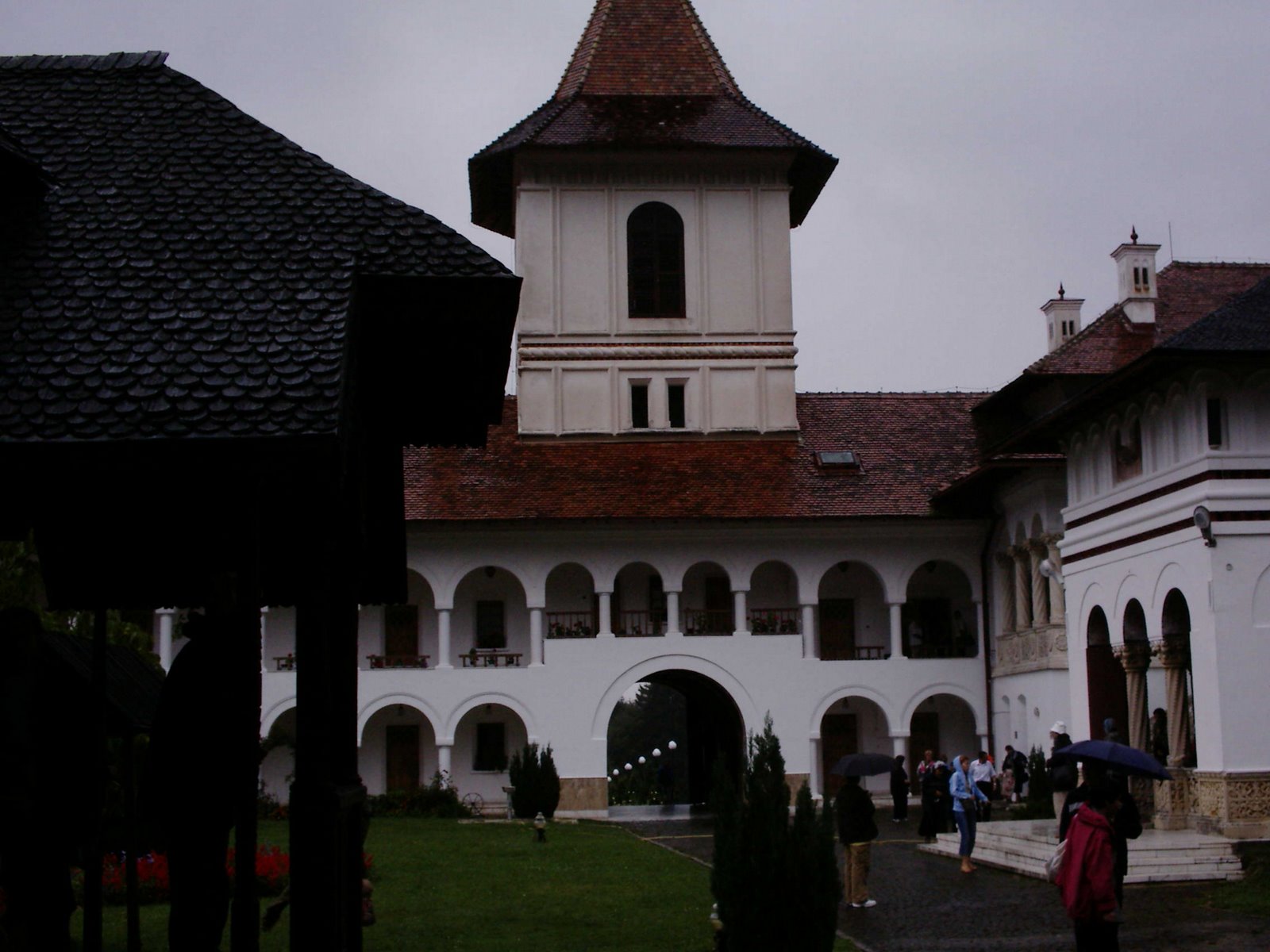
An orthodox monastery (though in Romania, not Russia)

This is a huge and complex book and it seems impossible to summarise it in a review. These are my preliminary impressions.

The size of the book
On first impressions, it is dauntingly big. Dostoevsky liked words and never used one when a dozen were available. It could have been shorter. And we must bear in mind what E M Forster, in Appendix A of Aspects of the Novel, says: “Long books, when read, are usually overpraised, because the reader wishes to convince others and himself that he has not wasted his time.” But, on the other hand, The Brothers Karamazov is often thought to be Dostoevsky’s masterpiece and is generally regarded as a classic of Russian literature. I suspect that is because it endeavours to do so many things.

A murder mystery?
The plot revolves around the murder of a rich old man, Fyodor Karamazov and the subsequent arrest and trial of one of his sons, Dmitry. It was said to have been inspired by a real case involving a man Dostoevsky knew when he was in exile in Siberia; this man was wrongfully convicted and subsequently exonerated of parricide.

It’s not a murder mystery in the conventional sense in that there are only two suspects, Dmitry and the villainous Smerdyakov, and the reader is pretty certain whodunnit. But it follows other tropes almost perfectly. Before the crime, Smerdyakov explains to Ivan, the middle brother, how it can be committed. When Dmitry is in the garden of his father’s house at night, clutching a weapon, there is a pause in the action ... and then he is fleeing the scene and being accused of parricide by an old servant whom he strikes. After the crime, there is a police investigation and the evidence is thoroughly dissected. The novel ends in a courtroom drama. This is classic stuff.

A retelling of the myth of Oedipus?
In some ways Dostoevsky’s story is a retelling of the Oedipus myth. Dmitry was abandoned by his father when he was very young and brought up initially by a servant and then a rich relative far away, as Oedipus was abandoned by Laertes, and taken in by poor folk and subsequently a foreign king. (At Dimitry’s trial the Defence Counsel makes much of this, suggesting that fatherhood is a two-way thing and therefore that this murder can’t be called parricide.) Oedipus accidentally marries his mother; Dmitry is in love with Grushenska, a woman also wooed by his father. So there are links. And Ivan the middle brother also harbours murderous thoughts towards his father, exclaiming (at Dmitry’s trial): “Who does not desire the death of his father?” (12.5) And the alternative suspect for the murder is allegedly the illegitimate son of Fyodor (a bit of a nineteenth-century cliche: always blame the bastard). So TBK has plenty for Freud to get his teeth into.

A romantic farce?
Not only are Dmitry and his father wooing the same woman, Grushenska, but Dmitry is already engaged to Katerina who, in turn, loves and is loved by Dmitry’s brother Ivan (sibling rivalry?). Grushenka is a notorious woman, having an old merchant ‘protector’ and having been ‘dishonoured’ when she was young by a Polish officer after whom she still secretly hankers. Ratikin is courting (for her money) Mrs Khakhlakov but she fancies Perkhotin.

A theological debate
If there is a hero, it is Alyosha, the third and youngest legitimate brother. At the start of the book, he is a monk in the local monastery but he spends an awful lot of his time visiting various different people around the town and therefore acting as a sort of thread binding the story together (although the principal narrator is an anonymous monk living in the monastery).

One of the major subplots involves Alyosha’s mentor at the monastery, the Elder Zosima, a sort of wise guru whose sayings and prophecies are suitable gnomic but whose reputation as a holy man takes a severe knock after he dies and his body goes putrid and smells (the body of a saint is supposedly incorruptible). Another subplot involves Alyosha effecting a reconciliation between warring schoolboys.

His elder brother, Ivan, is an academic and an atheist who has recently published an infamous article which suggests that if there is no God, then everything is lawful. His atheism isn’t absolute. He entertains the possibility of there being a God, but he finds it difficult to believe that this world is that created by God. The root of his disbelief stems from the fact that children suffer and this cannot be reconciled with the idea that compassion is at the heart of Christianity. Ivan is the focus of the theological debates in the book. He is the one who makes up the tale of the Grand Inquisitor which is perhaps the most famous part of the book: Jesus appears in fifteenth century Spain and is arrested and interrogated by the Grand Inquisitor who explains why giving mankind free will was a mistake. Ivan also hallucinates a conversation with the devil.

A book about redemption?
Dmitry realises that the only way he will reform is by spending twenty years in the Siberian mines and therefore he seems to believe that he possesses a nugget of redeemable character. Is this Dostoevsky suggesting that purgatory is the place where souls are redeemed on their way to paradise?

A prematurely postmodern psychological novel
Dostoevsky seems to me to be way ahead of his time in his understanding that people are inconsistent. To take a trivial example: a young girl called Lise (later called Liza) writes a love letter to Alyosha which she then repudiates, telling him it was a silly joke and then repudiates the repudiation, saying she loves him after all.

Dmitry is a more important example. He is a libertine and by his own (frequent) admission a scoundrel but he has a fine sense of honour and he insists he is not a thief. When he has money he splurges it and yet he keeps 1,500 roubles sewn into a bag around his neck. He gets drunk and enjoys women and yet at the same time he is desperately in love with Grushenska. The straight and narrow road is not for him: “I always liked side‐paths, little dark back‐alleys behind the main road—there one finds adventures and surprises, and precious metal in the dirt. I am speaking figuratively, brother. In the town I was in, there were no such back‐alleys in the literal sense, but morally there were. If you were like me, you’d know what that means. I loved vice, I loved the ignominy of vice.” (3.4)

Perhaps the most fascinatingly complex character is Kolya. He’s a clever schoolboy and he knows it. He’s vain but sufficiently self-aware to know when he is being boastful. He has rudimentary ideas of socialism and likes talking to the people but he is very patronising when he does. His school fellows admire him as a daredevil because of some of his pranks but he finds it a strain keeping this reputation up. He has a tender heart and is very fond of some young children whom he occasionally babysits. He hates his own name (Nikolay). He talks to Alyosha on equal terms (he calls him ‘Karamazov’) but he knows that Alyosha somehow sees Kolya’s naked soul.

Not all the characters are multi-dimensional. Fyodor Karamzov, the father, enjoys being a sensualist, he boasts about it. He explains to Alyosha why he needs his money: “As I get older, you know, I shan’t be a pretty object. The wenches won’t come to me of their own accord, so I shall want my money. So I am saving up more and more, simply for myself .... For I mean to go on in my sins to the end, let me tell you. For sin is sweet; all abuse it, but all men live in it, only others do it on the sly, and I openly. And so all the other sinners fall upon me for being so open. And your paradise, Alexey Fyodorovitch, is not to my taste, let me tell you that; and it’s not the proper place for a gentleman.” (4.2) At the start of the book Dostoevsky suggests that Fyodor accumulated his wealth by sponging, so that everyone always underestimated how rich he was, he also indulges in sharp practices (marrying for money and effectively cheating Dmitry out of his mother’s inheritance); by the time of the action of the novel, however, Fyodor has a reputation for being a rich voluptuary. Is this an inconsistency in the story or is Dostoevsky showing that even when a character is consistent, their reputation can be multi-faceted.

At the end of the book, at the trial, both Prosecutor and Defence Counsel interpret the actions of Dmitry in different ways: as the Defence says “psychology, gentlemen, though it is a deep thing, none the less resembles a stick with two ends” (12.10). It is pointed out that the lawyers are constructing competing stories. It is as if Dostoevsky is saying that there is no absolute truth but that all versions of reality are unreliable narrations, a very postmodern idea.

The unreliable narrator is also a trope of modernist fiction, so perhaps TBK is an early example of that. The ending of the book, which is only partially resolved, is another characteristic of modernism. 

Characters
In the end, the joy of TBK lies in some of the characters. Although I found Alyosha rather empty and bland and Smerdyakov is a purely pantomime villain, other characters are fascinating. My favourites were Mrs Khokhlakov, a wonderfully empty-headed widow, and the brilliant but vain but compassionate Kolya. At the other end of the age spectrum, who doesn't love an unredeeemed rake who takes joy in his wickedness, such as Fyodor Karamzov?

But perhaps the most interesting character is Ratikin. At the start he is almost unnoticeable, the seminarian in the background. But little by little he worms his way into the plot until he is a cross between a secret policeman and an agent provocateur. He is a spy for Mrs K. He takes money from Grushenska to bring Alyosha to her. He pops up everywhere! “It turned out that Ratikin knew everything, knew an extraordinary amount, had been to visit everyone, seen everything, spoken to everyone, and possessed a most detailed knowledge.” (12.2) Is he Dostoevsky's cynical self-portrait, like Velasquez in his Las Meninas? He writes slanderous articles (betraying Mrs K) for the Moscow press when the scandal of the murder breaks. Dmitry even says “He wants to write about me ... and thus inaugurate his role in literature.” (11.4) 

What I didn’t like
As with so many Russian novels, each character has three names: the first name, the patronymic and the surname. They are referred to either by first name and patronymic (eg Fyodor Pavolich) or by surname (eg Karamazov) or, most frequently, by a version of their first name (eg Alyosha, Mitya, Katya, etc). Some characters have more than one such nickname (often different people call them different things and this is a highlight of the book). In some cases we don’t learn the full name of a character until very late on in the book. This caused me considerable confusion at the start, not realising, for example, that Grushenska was also called Agrafena Alexandrovna. I really needed a cast list at the start of the book which listed all possible versions of their name.

The edition I had came with notes which often explained things that I wasn’t very interested in, such as the fact that a certain line was derived from a parody of Pushkin. What I absolutely needed was a translation of the many times that French or Latin was used. In the worst example, the devil tells a joke in French. There is an end-note ... which gives the full joke, still in French, and fails to translate it! Why do editors do this? I’m reading a translation ... but they can’t be bothered to translate anything that’s not Russian. Is it because they don’t know? Or is it because they do know and they expect me to know? Or is it because they do know and they know I don’t know and it is a way of asserting their superiority?

The implication that Smerdyakov was a rotter principally because he illegitimate. All of Fyodor Karamazov's sons get a rough start in life but poor old Smerdy is bullied and looked down on by everyone. The whole Russian economy depends on the peasants but, despite Dostoevsky's reputation as a revolutionary social reformer, his books are basically about the upper-classes, who are presumed, even when they are ill-educated and poverty-stricken, to be intrinsically nobler and worthier and better than the muzhiks. 

All those exclamation marks! There's only so much intensity that one can take. Dmitry lives his life in the fast lane, always seemingly on the edge of catastrophe, and Ivan seems perpetually on the brink of a nervous breakdown. Alyosha spends his time running from one crisis to another. It's like watching Macbeth when everyone shouts every line, or a ballet when the dancers never pause. Exhausting! The occasional funny bits, such as when Mrs K tries to interest Dmitri in gold mines, are a welcome relief. 

The narrative was somewhat lumpy. Two whole books (6 and 10) were almost extraneous additions. Book 6 tells of the life and works of the Elder Zosima and is almost completely irrelevant to the plot. Book 10 introduces a new character and acts as an interlude between Dmitry's arrest and his trial.

And, while I appreciate that every character needs a back story, does every character need that back-story told? I suppose these sometimes provided welcome breaks from the intensity of the action but I really didn't need to know, for example, why Zosima became a monk.

Evaluation
Yes it is much too long. There were passages of intricate theological and legal argument when I was numb with weariness. But even an inadequate review like the one above must give some idea of the wealth that is in this book. A classic? Undoubtedly.

Selected quotes:
  • “The more I love mankind in general, the less I love human beings in particular. ... In the space of a day and a night I am capable of coming to hate even the best of human beings: one because he takes too long over dinner, another because he has a cold and is perpetually blowing his nose.” (2.4)
  • “All these deportations to forced labour, ... reform no one, and more importantly have no deterrent effect, either.” (2.5)
  • “It had rats, but Fyodor Pavlovitch did not altogether dislike them. ‘They help to relieve the monotony when one’s alone in the evening,’ he used to say.” (3.1)
  • “But I always liked side‐paths, little dark back‐alleys behind the main road—there one finds adventures and surprises, and precious metal in the dirt. I am speaking figuratively, brother. In the town I was in, there were no such back‐alleys in the literal sense, but morally there were. If you were like me, you’d know what that means. I loved vice, I loved the ignominy of vice.” (3.4)
  • “The ladder’s the same. I’m at the bottom step, and you’re above, somewhere about the thirteenth. That’s how I see it. But it’s all the same. Absolutely the same in kind. Anyone on the bottom step is bound to go up to the top one.” (3.4)
  • “As I get older, you know, I shan’t be a pretty object. The wenches won’t come to me of their own accord, so I shall want my money. So I am saving up more and more, simply for myself,.... For I mean to go on in my sins to the end, let me tell you. For sin is sweet; all abuse it, but all men live in it, only others do it on the sly, and I openly. And so all the other sinners fall upon me for being so open. And your paradise, Alexey Fyodorovitch, is not to my taste, let me tell you that; and it’s not the proper place for a gentleman.” (4.2)
  • “Even in these days the law does not allow you to drag your old father about by the hair, to kick him in the face in his own house, and brag of murdering him.” (4.2)
  • “In schools, children are a tribe without mercy: on their own they are heaven’s own angels, but together, especially in schools, they are often merciless.” (4.7)
  • “The very kindest and best of men are those who are most drunk.” (4.7)
  • "If I didn’t believe in life, if I lost faith in the woman I love, lost faith in the order of things, were convinced in fact that everything is a disorderly, damnable, and perhaps devil‐ridden chaos, if I were struck by every horror of man’s disillusionment—still I should want to live and, having once tasted of the cup, I would not turn away from it till I had drained it! At thirty, though, I shall be sure to leave the cup, even if I’ve not emptied it, and turn away—where I don’t know. But till I am thirty, I know that my youth will triumph over everything—every disillusionment, every disgust with life. I’ve asked myself many times whether there is in the world any despair that would overcome this frantic and perhaps unseemly thirst for life in me, and I’ve come to the conclusion that there isn’t, that is till I am thirty, and then I shall lose it of myself, I fancy. Some drivelling consumptive moralists—and poets especially—often call that thirst for life base. It’s a feature of the Karamazovs, it’s true, that thirst for life regardless of everything; you have it no doubt too, but why is it base? The centripetal force on our planet is still fearfully strong, Alyosha. I have a longing for life, and I go on living in spite of logic.” (5.3)
  • “And so Our Lady, shocked and weeping, falls before the throne of God and begs for mercy for all in hell—for all she has seen there, indiscriminately.” (5.5)
  • “We had four servants, all serfs. I remember my mother selling one of the four, the cook Afimya, who was lame and elderly, for sixty paper roubles, and hiring a free servant to take her place.” (6.1)
  • “Much knowledge soon makes one old.” (7.3)
  • “He felt unbearably awkward. All were clothed, while he was naked, and strange to say, when he was undressed he felt somehow guilty in their presence, and was almost ready to believe himself that he was inferior to them, and that now they had a perfect right to despise him.” (9.6)
  • “I have, as it were, torn my soul in half before you, and you have taken advantage of it and are rummaging with your fingers in both halves along the torn place.” (9.7)
  • “I’ve sworn to amend, and every day I’ve done the same filthy things. I understand now that such men as I need a blow, a blow of destiny to catch them as with a noose, and bind them by a force from without. Never, never should I have risen of myself! But the thunderbolt has fallen. I accept the torture of accusation, and my public shame, I want to suffer and by suffering I shall be purified. Perhaps I shall be purified, gentlemen?” (9.9)
  • “The study of the classics, if you ask my opinion, is a police measure, that’s why it has been introduced into our schools. Latin and Greek were introduced because they are a bore and because they stupefy the intellect. It was dull before, so what could they do to make things duller? It was senseless enough before, so what could they do to make it more senseless? So they thought of Greek and Latin.” (10.5)
  • “Everything will change , and finally, nothing, they will all be old men staring into their coffins.” (11.2)
  • “Everyone says they hate immorality, yet secretly they all like it.” (11.3)
  • “De thoughtibus non est disputandum.” (11.4) It’s a rewrite of the philosophical maxim: de gustibus non est disputandum which means ‘you can’t argue over matters of taste’ (that is, if I like something and you don’t, you can’t dispute it) Dostoevsky’s maxim, put into the mouth of Dmitri, is ‘you can’t argue over thoughts ie philosophies’
  • “How is man to fare after that? Without God and without a life to come? After all, that would mean that now all things are lawful, that one may do anything one likes.” (11.4)
  • “Just try admitting to a woman your guilt ... On no account will she forgive you in a simple, straightforward manner, no, she will degrade you to the level of the floor-cloth, she will find things that never even happened, will take everything, forget nothing, add things of her own, and only then forgive.” (11.4)
  • “What would become of an axe in space? Quelle idée! If it were to fall to any distance, it would begin, I think, flying round the earth without knowing why, like a satellite.” (11.9)
  • “Who does not desire the death of his father?” (12.5)
February 2024; 985 pages

Other books by Dostoevsky include:


This review was written by

the author of Bally and Bro, Motherdarling 

and The Kids of God