Showing posts with label Dickens. Show all posts

Thursday, 27 July 2023

"David Copperfield" by Charles Dickens


 This autobiographical novel (DC = CD, get it?) is sometimes regarded as the best Dickens wrote. It came 15th in The Guardian's 100 best novels of all time and 8th in the BBC's best novels of all time. I reread it in preparation for reading Demon Copperhead by Barbara Kingsolver.

DC is the fictionalised biography of CD, starting with his birth. It is often regarded as one of the best novels by Dickens, his personal favourite, and marks a break between his early novels (Pickwick, Oliver Twist, Nicholas Nickleby, The Old Curiosity Shop, Barnaby Rudge, and Martin Chuzzlewit, of which only the first two are regularly read nowadays), and his later, more serious work, such as Bleak House, Great Expectations, and Our Mutual Friend. 

Dickens was, in his day, phenomenally best-selling, and he is still hugely popular, though honoured nowadays more in film and television adaptations of his works than in actual readers. His characters are extraordinarily memorable. But is his work actually any good?

The first problem that a modern reader is likely to encounter with Copperfield is its length. It's about 360,000 words, about four or five times as long as a typical modern novel (although, to be fair, it's only about half as long as the Bible); the Audible audiobook lasts 34.5 hours. A lot happens, but there are also some awfully long passages. Most people quail at the long descriptions but they seemed proportionate to me (and sometimes brilliant). What I found difficult was the extended speeches, often very melodramatic, particularly when a character becomes distressed: 

  • "‘Oh, Trotwood, Trotwood!’ exclaimed Mr. Wickfield, wringing his hands. ‘What I have come down to be, since I first saw you in this house! I was on my downward way then, but the dreary, dreary road I have traversed since! Weak indulgence has ruined me. Indulgence in remembrance, and indulgence in forgetfulness. My natural grief for my child’s mother turned to disease; my natural love for my child turned to disease. I have infected everything I touched. I have brought misery on what I dearly love, I know—you know! I thought it possible that I could truly love one creature in the world, and not love the rest; I thought it possible that I could truly mourn for one creature gone out of the world, and not have some part in the grief of all who mourned. Thus the lessons of my life have been perverted! I have preyed on my own morbid coward heart, and it has preyed on me. Sordid in my grief, sordid in my love, sordid in my miserable escape from the darker side of both, oh see the ruin I am, and hate me, shun me!’" (Ch 39)
  • "Oh what will you feel when you see this writing, and know it comes from my wicked hand! But try, try—not for my sake, but for uncle’s goodness, try to let your heart soften to me, only for a little little time! Try, pray do, to relent towards a miserable girl, and write down on a bit of paper whether he is well, and what he said about me before you left off ever naming me among yourselves—and whether, of a night, when it is my old time of coming home, you ever see him look as if he thought of one he used to love so dear. Oh, my heart is breaking when I think about it! I am kneeling down to you, begging and praying you not to be as hard with me as I deserve—as I well, well, know I deserve—but to be so gentle and so good, as to write down something of him, and to send it to me. You need not call me Little, you need not call me by the name I have disgraced; but oh, listen to my agony, and have mercy on me so far as to write me some word of uncle, never, never to be seen in this world by my eyes again! Dear, if your heart is hard towards me—justly hard, I know—but, listen, if it is hard, dear, ask him I have wronged the most—him whose wife I was to have been—before you quite decide against my poor poor prayer! If he should be so compassionate as to say that you might write something for me to read—I think he would, oh, I think he would, if you would only ask him, for he always was so brave and so forgiving—tell him then (but not else), that when I hear the wind blowing at night, I feel as if it was passing angrily from seeing him and uncle, and was going up to God against me. Tell him that if I was to die tomorrow (and oh, if I was fit, I would be so glad to die!) I would bless him and uncle with my last words, and pray for his happy home with my last breath!" (Ch 40)

 Dickensian characters don't have stiff upper lips.

There are an awful lot of characters. I recently advised a fledgling novelist to reduce the number of characters in her draft novel because (a) it is difficult for the reader to keep track of multiple characters and (b) it is difficult for the author to create distinct and properly rounded characters if a new one pops up every so often. To be fair to Dickens, when you are writing what is in effect a whole life, there must inevitably be a lot of characters: one's early playmates, schoolfriends, early romantic attachments, workmates etc. To be fair to Dickens again, many of the characters he introduces reappear later in the book (although sometimes, as with the final appearances of Creakle, Heep and Littimer, these have the appearance of being rather forced and moralistic tying up of loose ends). To be fair to Dickens a third time, he introduces each character with a few sentences which make them instantly memorable; his characters often have a quirk or a catchphrase which he repeats in order to evoke them each time they appear. But, on the other hand, he fails, in my opinion, to create many fully rounded characters. Most of his characters, vivid though they may be, are caricatures. They're one dimensional. They never surprise the reader. Heep is a villain from start to end, Dora is a child-wife, Ham is the salt of the earth. These aren't people, they're puppets. Perhaps the only character who felt real was Rosa Dartle, though she's not so much a character as a way of using irony to point out the falseness and hypocrisy in other people, and in the (melodramatic) end she too was revealed as just another mask.

So I feel justified in what I told the new novelist. Dickens is extraordinary in that he can create characters that stick with you (by his tricks of quirk and catchphrase) but even he can't create a multiplicity of three-dimensional characters.

It's great fun, it's entertaining, but fundamentally, for me, this novel fails as a work of literature because Dickens fails to ask why his characters are as they are. For all his social campaigning (against workhouses in Oliver Twist, against abusive schools in Nicholas Nickleby, against abusive schools, and the Doctors' Commons, and the solitary system in prisons in Copperfield etc) Dickens accepted the basic Victorian social divide between the classes. Thus our hero retains his dignity despite becoming a poor labourer ("I worked, from morning until night, with common men and boys, a shabby child." (Ch 11), there being no suggestion that DC himself is 'common')and a homeless (Dickens uses the word "houseless") tramp, because he is of good birth; he is rescued by his aunt who lives on her investments. Steerforth may be a cad but he is a gentleman and therefore David ultimately forgives him. Peggoty and Barkis and Ham and the other picturesque members of the working servant classes are tolerated because they know their place. Heep, on the other hand, commits the unforgivable sin of resenting his lower class birth and wanting to better himself (He does have a couple of pages in which he talks about his low birth and how being "umble" was his way to rise but Dickens seems to have cut him no slack on this account.)

(This reminds me of Oliver Twist. The eponymous hero is an orphan who grows up in a workhouse. One would have expected him to have been brutalised. But Dickens, in an introduction to the novel, explained that he wanted to write a story which showed that those of gentle birth would, despite their circumstances, retain their innate nobility and in so doing he created one of the most unbelievable title characters in literature.)

David Copperfield is a pantomime with goodies and baddies.

But the scenery is brilliant. He can describe something so that you are immediately in the picture:

  • "It was beautifully clean inside, and as tidy as possible. There was a table, and a Dutch clock, and a chest of drawers, and on the chest of drawers there was a tea-tray with a painting on it of a lady with a parasol, taking a walk with a military-looking child who was trundling a hoop. The tray was kept from tumbling down, by a bible; and the tray, if it had tumbled down, would have smashed a quantity of cups and saucers and a teapot that were grouped around the book. On the walls there were some common coloured pictures, framed and glazed, of scripture subjects; such as I have never seen since in the hands of pedlars, without seeing the whole interior of Peggotty’s brother’s house again, at one view. Abraham in red going to sacrifice Isaac in blue, and Daniel in yellow cast into a den of green lions, were the most prominent of these. Over the little mantelshelf, was a picture of the ‘Sarah Jane’ lugger, built at Sunderland, with a real little wooden stern stuck on to it; a work of art, combining composition with carpentry, which I considered to be one of the most enviable possessions that the world could afford. There were some hooks in the beams of the ceiling, the use of which I did not divine then; and some lockers and boxes and conveniences of that sort, which served for seats and eked out the chairs." (Ch 3)
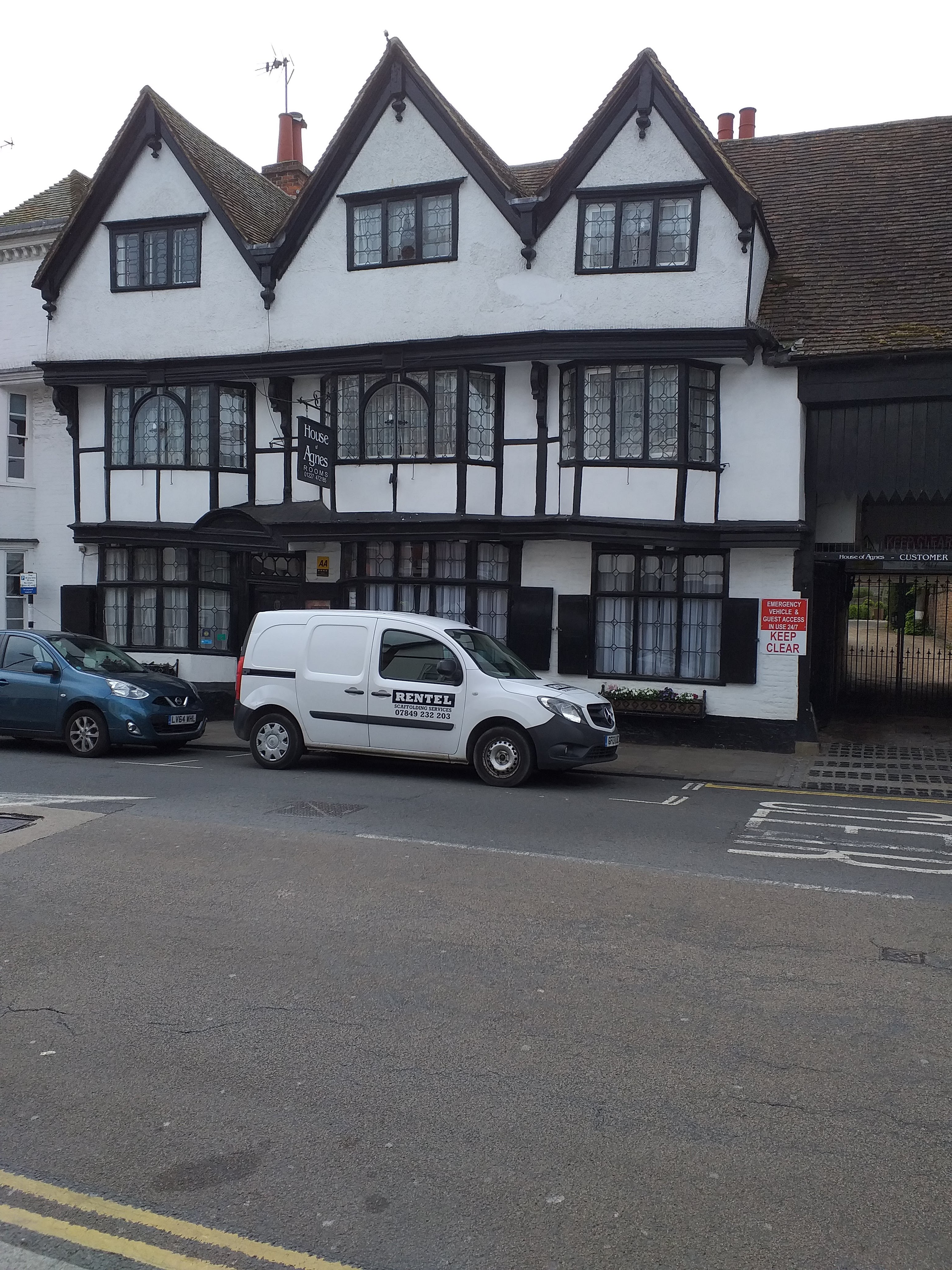
  • "At length we stopped before a very old house bulging out over the road; a house with long low lattice-windows bulging out still farther, and beams with carved heads on the ends bulging out too, so that I fancied the whole house was leaning forward, trying to see who was passing on the narrow pavement below. It was quite spotless in its cleanliness. The old-fashioned brass knocker on the low arched door, ornamented with carved garlands of fruit and flowers, twinkled like a star; the two stone steps descending to the door were as white as if they had been covered with fair linen; and all the angles and corners, and carvings and mouldings, and quaint little panes of glass, and quainter little windows, though as old as the hills, were as pure as any snow that ever fell upon the hills." (Ch 15): This house still exists in Canterbury; it is called the 'House of Agnes'.
  • "The neighbourhood was a dreary one at that time; as oppressive, sad, and solitary by night, as any about London. There were neither wharves nor houses on the melancholy waste of road near the great blank Prison. A sluggish ditch deposited its mud at the prison walls. Coarse grass and rank weeds straggled over all the marshy land in the vicinity. In one part, carcases of houses, inauspiciously begun and never finished, rotted away. In another, the ground was cumbered with rusty iron monsters of steam-boilers, wheels, cranks, pipes, furnaces, paddles, anchors, diving-bells, windmill-sails, and I know not what strange objects, accumulated by some speculator, and grovelling in the dust, underneath which—having sunk into the soil of their own weight in wet weather—they had the appearance of vainly trying to hide themselves. The clash and glare of sundry fiery Works upon the river-side, arose by night to disturb everything except the heavy and unbroken smoke that poured out of their chimneys. Slimy gaps and causeways, winding among old wooden piles, with a sickly substance clinging to the latter, like green hair, and the rags of last year’s handbills offering rewards for drowned men fluttering above high-water mark, led down through the ooze and slush to the ebb-tide. There was a story that one of the pits dug for the dead in the time of the Great Plague was hereabout; and a blighting influence seemed to have proceeded from it over the whole place. Or else it looked as if it had gradually decomposed into that nightmare condition, out of the overflowings of the polluted stream." (Ch 47)
Some of his immediate characterisations

  • "He was a limp, delicate-looking gentleman, I thought, with a good deal of nose, and a way of carrying his head on one side, as if it were a little too heavy for him." (Ch 6)
  • Uriah Heep, to be damned from the outset (all Ch 16)
    • His catchphrase: "I’m a very umble person." (False humility added to dropped aitches)
    • His behavioural quirks: 
      • "he frequently ground the palms against each other as if to squeeze them dry and warm, besides often wiping them, in a stealthy way, on his pocket-handkerchief"
      • "He had a way of writhing when he wanted to express enthusiasm, which was very ugly; and which diverted my attention from the compliment he had paid my relation, to the snaky twistings of his throat and body."

Selected quotes:

  • "The man with the wooden leg eyed me all over—it didn’t take long, for there was not much of me" (Ch 5)
  • "A cloggy sensation of the lukewarm fat of meat is upon me" (Ch 7)
  • "I used at first to wonder what comfort Traddles found in drawing skeletons; and for some time looked upon him as a sort of hermit, who reminded himself by those symbols of mortality that caning couldn’t last for ever. But I believe he only did it because they were easy, and didn’t want any features." (Ch 7)
  • "I was in the carrier’s cart when I heard her calling to me. I looked out, and she stood at the garden-gate alone, holding her baby up in her arms for me to see. It was cold still weather; and not a hair of her head, nor a fold of her dress, was stirred, as she looked intently at me, holding up her child. So I lost her." (Ch 8)
  • "I am conscious of having confounded it with those demoniacal parchments which are held to have, once upon a time, obtained to a great extent in Germany." (Ch 11)
  • "she was one of a series of protegees whom my aunt had taken into her service expressly to educate in a renouncement of mankind, and who had generally completed their abjuration by marrying the baker." (Ch 13)
  • "a grave building in a courtyard, with a learned air about it that seemed very well suited to the stray rooks and jackdaws who came down from the Cathedral towers to walk with a clerkly bearing on the grass-plot" (Ch 16)
  • "‘It was as true,’ said Mr. Barkis, ‘as turnips is. It was as true,’ said Mr. Barkis, nodding his nightcap, which was his only means of emphasis, ‘as taxes is. And nothing’s truer than them.’" (Ch 21)
  • "they had a weazen little baby, with a heavy head that it couldn’t hold up, and two weak staring eyes, with which it seemed to be always wondering why it had ever been born." (Ch 22)
  • "The whole building looked to me as if it were learning to swim; it conducted itself in such an unaccountable manner, when I tried to steady it." (Ch 24) (Being drunk, a delightful description)
  • "Miss Murdstone, like the pocket instrument called a life-preserver, was not so much designed for purposes of protection as of assault." (Ch 26)
  • "'I smoke, myself, for the asthma.' Mr. Omer had made room for me, and placed a chair. He now sat down again very much out of breath, gasping at his pipe as if it contained a supply of that necessary, without which he must perish." (Ch 30)
  • "Try not to associate bodily defects with mental, my good friend, except for a solid reason." (Ch 32)
  • "Frozen-out old gardeners in the flower-beds of the heart" (Ch 33)
  • "There’s an account about the people being hungry and discontented down in the North, but they are always being hungry and discontented somewhere." (Ch 36)
  • "To a man possessed of the higher imaginative powers, the objection to legal studies is the amount of detail which they involve." (Ch 39)
  • "they all seemed to treat Dora, in her degree, much as Dora treated Jip [her pet dog]in his." (Ch 41)
  • "From babies who had but a week or two of life behind them, to crooked old men and women who seemed to have but a week or two of life before them; and from ploughmen bodily carrying out soil of England on their boots, to smiths taking away samples of its soot and smoke upon their skins; every age and occupation appeared to be crammed into the narrow compass of the ‘tween decks." (Ch 57)
  • "what such people miscall their religion, is a vent for their bad humours and arrogance." (Ch 59)
  • "the prison ... was an immense and solid building, erected at a vast expense. I could not help thinking, as we approached the gate, what an uproar would have been made in the country, if any deluded man had proposed to spend one half the money it had cost, on the erection of an industrial school for the young, or a house of refuge for the deserving old." (Ch 61)

Rather too long; otherwise very entertaining with a huge cast of eccentric and memorable, but not very credible, characters.

July 2023; 991 pages



This review was written by

the author of Bally and Bro, Motherdarling 

and The Kids of God

Other works by Dickens, including those reviewed in this blog, can be found on this page.

Dickens: A Biography by Fred Kaplan


Wednesday, 5 April 2023

"Great Expectations" by Charles Dickens


Placed 4th in the BBC's best novels of all time, this is one of the most popular of the novels of Charles Dickens, Great Expectations is a bildungsroman narrated in the first person, in the past tense, warning of the dangers of trying to turn a working-class boy into a gentleman. (In Oliver Twist, the hero can be successfully transformed because, despite his upbringing in a workhouse, he is of good birth and nature trumps nurture. For all his early support of social reform, Dickens, himself a middle-class boy who had been plunged into the lower classes by the improvidence of his parents before escaping through his writing, was a great believer that the social hierarchy of Victorian Britain was god-ordained.)

A with most novels by Dickens, it's plot is heavily convoluted. It was originally published in serial form so a cliff-hanger is needed every few chapters. The hook at the start of the book occurs at the bottom of the first page.

Again, as is typical with Dickens, it contains extravagantly grotesque but utterly memorable characters. Dickens develops his characters through their appearances, often succinctly but vividly described (eg "an old-looking young man of a heavy order of architecture"; Ch 23), their behavioural characteristics (eg the way Mrs G cuts bread in chapter 2) and the peculiarities of their speech (Joe Gargery being the prime example in this novel). Some of the cast are little more than comic decorations (eg Trabb's boy, Pumblechook and Mr Wopsle, and the Aged P). But even his major characters rarely develop. Joe is salt-of-the-earth throughout. It takes brain damage to make Mrs Gargery nice. Jaggers is Jaggers, Wemmick is Wemmick, Estelle is Estelle. They are little more than scenery with which the hero can interact, against whom he can fulfil his potentialities. Only the half-mad Miss Havisham, to a very limited extent, and Pip, who is growing up, change. This is what limits Great Expectations. It is hugely entertaining but it is entertainment rather than art.

It is like a painting that impresses one by the skill shown in creating a two-dimensional scene with three-dimensional verisimilitude. Dickens achieves this with his detailed descriptions of settings. He clearly knew these places intimately and he can recreate them in the mind of the readers. Many of these settings are classic Gothic melodrama settings: the deserted churchyard on the misty marshes, the tumbledown crowded buildings in London, the desolate dereliction of Miss Havisham's house. But, as with his characters, they are utterly memorable.

The start of the plot:
Pip, an orphan living with his sister and her blacksmith husband on the marshes of the Thames estuary in Kent, encounters an escaped convict, Magwitch, and is terrified into helping him. Later, he is sent as a playmate for the girl being brought up by Miss Havisham, a rich recluse who retired from the world when she was jilted on her wedding day. Years later, when Pip is an apprentice blacksmith, he is told by a London lawyer that he has great expectations of inheriting a substantial fortune but the identity of the donor is to be kept hidden. Pip, believing the donor to be Miss Havisham, goes to London to be educated as a gentleman, and starts to look down on his former family and friends.

Of course, being Dickens, there are multiple sub-plots, all of which, however fancifully, are resolved in the end. Had I written the book I would have excised at least the Orlick plot; it isn't necessary, it over-complicates the plot, it blurs the focus. 

Fundamentally, though, the novel, though long, is easy to read, is packed full of incident, has a wonderful cast, and, as entertainment, is superb. 

Selected quotes:
  • "Mrs. Joe was a very clean housekeeper, but had an exquisite art of making her cleanliness more uncomfortable and unacceptable than dirt itself. Cleanliness is next to Godliness, and some people do the same by their religion." (Ch 4)
  • "In his working-clothes, Joe was a well-knit characteristic-looking blacksmith; in his holiday clothes, he was more like a scarecrow in good circumstances, than anything else. Nothing that he wore then fitted him or seemed to belong to him; and everything that he wore then grazed him." (Ch 4)
  • "A fire had been lately kindled in the damp old-fashioned grate, and it was more disposed to go out than to burn up, and the reluctant smoke which hung in the room seemed colder than the clearer air,—like our own marsh mist." (Ch 11)
  • "I felt as if the stopping of the clocks had stopped Time in that mysterious place, and, while I and everything else outside it grew older, it stood still." (Ch 17)
  • "Joe, still looking at the fire, and holding his knees tight, as if he had private information that they intended to make off somewhere" (Ch 18)
  • "I went to the hatter’s, and the bootmaker’s, and the hosier’s, and felt rather like Mother Hubbard’s dog whose outfit required the services of so many trades" (Ch 19) The Comic Adventures of Old Mother Hubbard and her Dog was written by Sarah Catherine Martin and published in 1805; it is an extended poem which relates the adventures of a lady whose original is said to have lived in a thatched cottage in Yealmpton, Devon which can still be seen. It was a great success and the first verse (which is supposed to be of ancient origin) is still known as a nursery rhyme today: Old Mother Hubbard/ Went to the cupboard/To give the poor Dog a bone;/When she came there,/The Cupboard was bare,/And so the poor Dog had none." The rest of the book describes the various different tradespeople to whom Mother Hubbard goes to ensure that the dog is properly cared for.
  • "I found him to be a dry man, rather short in stature, with a square wooden face, whose expression seemed to have been imperfectly chipped out with a dull-edged chisel. There were some marks in it that might have been dimples, if the material had been softer and the instrument finer, but which, as it was, were only dints. The chisel had made three or four of these attempts at embellishment over his nose, but had given them up without an effort to smooth them off." (Ch 21)
  • "no varnish can hide the grain of the wood; ... the more varnish you put on, the more the grain will express itself." (Ch 22)
  • "'me and Wopsle went off straight to look at the Blacking Ware’us. But we didn’t find that it come up to its likeness in the red bills at the shop doors; which I meantersay, added Joe, in an explanatory manner, as it is there drawd too architectooralooral'.” (Ch 27) When his family fell on hard times, the young Charles Dickens worked at Warren's Blacking (at 30, Hungerford Stairs, just off the Strand; the factory was demolished and the site is now Incorporated within Charing Cross Station) which made boot polish. Dickens was always ashamed of his time here.
  • "All other swindlers upon earth are nothing to the self-swindlers, and with such pretences did I cheat myself. Surely a curious thing. That I should innocently take a bad half-crown of somebody else’s manufacture is reasonable enough; but that I should knowingly reckon the spurious coin of my own make as good money!" (Ch 28)
  • it seems to me that in the despondency of the tender passion, we are looking into our gift-horse’s mouth with a magnifying-glass." (Ch 30)
  • “'—Invest portable property in a friend?' said Wemmick. 'Certainly he should not. Unless he wants to get rid of the friend,—and then it becomes a question how much portable property it may be worth to get rid of him'.” (Ch 36)
  • "looking at the tangle of tobacco in his hand, he seemed to think it might perplex the thread of his narrative." (Ch 41)
  • "The death close before me was terrible, but far more terrible than death was the dread of being misremembered after death." (Ch 53)
April 2023; 460 pages


This review was written by

the author of Bally and Bro, Motherdarling 


I have been watching the BBC TV 2023 six-part adaptation. Here are some of my thoughts.
  • How old is Pip?
    • He seems to be a young boy at the start of the novel; most commentators suggest he is seven or eight. But the BBC adaptation shows a rather older boy, eleven or older, with the attitude of a surly teenager. So I tried to enquire more deeply into Pip's chronology. According to the text, he goes to Miss Havisham's a year after the convict incident. He still seems a little boy: the only card game he can play is Beggar My Neighbour. But ten months after this, he is apprenticed to Joe. But in those days, apprenticeships normally started at about age fourteen, and one would have thought that a lad younger than that wouldn't have the physical strength needed for blacksmithery. He stays apprentice for four years before his Expectations take him to London where he is for an undetermined period (three years or so?) before her comes of age at 21. This suggests that there are some missing years, and that they should be within the Miss Havisham experience. 
    • If we take the BBC line, that he is say twelve at the start of the book (and not nearly so naive as the text implies) then his Expectations come six years later. But this won't work. Magwitch in Australia has to do seven years forced labour before being able to start out on his own. and making a fortune (and that presumably takes a few years). Even if he comes into his Expectations at the age of 20 (it must be before 21) we don't have enough time. The only way we can reconcile the Magwitch back story with the Pip story is if he encounters the convict on the marshes when he is at most ten years old. 


Thursday, 7 April 2022

"The Dickens Boy" by Thomas Keneally

 The fictionalised biography of Edward 'Plorn' Dickens, son of the famous novelist. Plorn, an academically challenged sixteen-year-old who has never read his father's books, is sent to Australia to become a sheep-rancher. We learn a great deal about the frontier Australia of the day, about sheep-farming and the newly-dispossessed aborigines, and the logistical and social contexts of farming a remote homestead. Plorn's experiences of love and loss, of kindness and hatred and danger, and his gradual understanding of sex and its relation to the scandalous divisions between his mother and father, help him to grow up.

This is a slow-paced book, gently told. The essential themes are 'coming of age' and the difficulties of being a normal son of a famous father. But the problem with 'true' stories is that some events happen and then other ones do, without the unification imposed by a nove's structure. For example, what promises to be a major character dies quite early in the narrative and another fades out. Then other characters have to arrive to carry the story. And some situations, as in real life, never get fully resolved. While this adds verisimilitude, it makes the book less of a  page-turner. Certainly I was less motivated to read it than by Keneally's most famous book 'Schindler's Ark', the bionovel on which 'Schindler's List' was based (the book is better because it really explores the shadowy fringes of heroism). 

Selected quotes:

  • "How far did the reverberations of my famous father reach? Colonies of birds in the desert oaks were engaging in the last clamorous parliament of their day, but Dickens was in the hut at the heart of Ullollie!" (Ch 7)
  • "I'd felt inexpressibly strange and even repelled by the idea of my father and mother being one flesh and sharing somehow the stew and the sanctity of that." (Ch 9)
  • "The priest uttered his benediction in Latin and very exactly quartered the air to make a cross above the company's heads." (Ch 26)
  • "This performer strove for relevance by means of volume." (Ch 33) The context suggests that the performer was loud but it could be read as a snide comment of writers such as Dickens who, at least in Plorn's view, achieve their effects by the quantity of their text.

April 2022; 390 pages


This review was written by

the author of Motherdarling 

and The Kids of God

Friday, 29 October 2021

"Dickens: A Biography! by Fred Kaplan

 Much of what I already knew about Dickens (his father was a financial disaster, he was traumatised by being taken from school and sent to work in a factory with lower class children, he was an instantly successful novelist, he worked hard and wrote copiously, he loved amateur theatricals, he rejected his wife of twenty years and ten children in favour of a young actress) is repeated in this biography. It is all part of the myth. It must be difficult to write a Life of Dickens without repeating the same old stuff. 

What surprised me was the emphasis on the spare-time activities of the novelist. Kaplan gives us chapter and verse of his holidays, his friendships, his business arrangements, his amateur theatricals etc. There is much less about the activity that dominated his life: his writing.

The book is far more interested in the later works. For example, there is no plot summary of Nickleby or Martin Chuzzelwit but more than three pages are devoted to the plot of Great Expectations. Not only is this manifestly unfair, but I would argue that the first two books are far less well known that the last, so Kaplan seems to be telling the reader what the reader already knows.

I suppose that Kaplan's biographer's instinct seeks to uncover the links between reality and fiction. For the later books, say from Bleak House onwards, Kaplan explains where the theme comes from (eg Hard Times which is about the conditions of the industrial revolution is inspired by a strike in Preston) and the model for many of the characters (Leigh Hunt for Horace Skimpole in Bleak House) but it would appear that the earlier books (PickwickOliver TwistNicholas Nickleby) were spontaneously generated. 

What interests me, as an author, is how Dickens honed his craft. Kaplan tells us: "In the novels that were to follow [David Copperfield] ... he was to use autobiographical tonalities for more subjective portraiture and psychological dramatization than in his earlier work." (7.3) He also reveals that , in the run up to writing Little Dorrit, "Dickens had begun to jot down ideas for stories and character sketches and lists of titles and names for characters in a small notebook ... He had never before kept a working notebook." (10.2) But, again, these considersations are dwarfed by discussion of Dickens travelling in Paris.

As for specifically technique-based discussion, all I could find was that Kaplan talks about the use of dual narrators (omniscient and first person) in Bleak House (but doesn't tell us how or why Dickens chose that difficult technique) and that "Collins' major objection to Dickens' fiction ... was that he did not tell his audience enough. For Collins, the art of fiction demanded a series of self-conscious signposts directing the reader toward an unraveling of a well-constructed plot. For Dickens, plot revelations needed to rise organically from the interaction of characters in a narrative pattern in which suggestion and symbol appealed to the reader's intuition." (12.3). 

Perhaps I was hoping for too much. Perhaps biography can't deliver a connection between an author's life and the development of his craft; perhaps this link is too subtle to leave traces. But there were moments in this biography when I wondered whether writing was part of what Dickens did.

As for the person, he certainly emerges as a rather unpleasant man. His vindictiveness when he ditched his wife was horrid: he ditched his long-standing publishers, his partners in a magazine, to their great cost, when they refused to print a self-serving statement about his marriage in Punch, the humorous magazine, which they owned, on the grounds that it wasn't humour. He was determined to squash the rumours that he was separating from his faithful wife to have an affair with a much younger woman because he was fearful that allegations of impropriety would damage the Dickens 'family values' brand. He demanded his children (except for his eldest son) stayed with him and never saw their mother. His daughter, Kate, is reprted in this biography as saying: "My father was like a madman when my mother left home ... The affair brought out all that was worst - all that was weakest in him. He did not care a damn what happened to any of us." (11.3)

He was hugely money-motivated. He took on far more work than a normal person could cope with because he was desperate for money. He couldn't resist the lure of reading tours, although he was advised against them as they made him very ill and perhaps shortened his life, because of the huge incomes they generated even when he was already hugely rich. I suppose he was haunted by the memories of his debt-ridden childhood.

He was ashamed of his sons. "Having been born to neither wealth nor title, his sons, Dickens assumed, should go out, as he had, into the world, and make their fortune. ... Whatever the mixture of motives, after 1858 he promoted their early departure, even when it pained him to see them leave." (12.1) It is not unusual that self-made men take the attitude that 'if I can make it, everyone can' without realising that their success is due to the fact that they are highly unusual (or very lucky). It is a paradox that an author who championed the weak and the poor never recognised this fact about himself.

Selected Quotes:

  • "From early on, he developed a performance personality, encouraged to believe that applause was approval." (1.3)
  • "He cared more for his work than for her." (3.2)
  • "The distortion of logic, reason, ethics, and the Bible by defenders of slavery seemed not only self-serving but also self-destructive." (5.3)
  • "Individualism, in the marketplace, in politics. and now on the frontier, seemed to him anticommunal, intolerably lonely, brazenly selfish, inherently materialistic, and threateningly brutal." (3.5)
  • "Having struggled out of the blacking factory to be a gentleman of the sort that America did not encourage, he identified with the upper middle class's assumption of aristocratic personal values and liberal middle-class politics." (3.5)
  • "The widespread assertion that drunkenness was the cause of many evils rather than a result of already existing ones angered him, as if eradication a symptom in any way dealt with the disease." (6.4)
  • "He thought 'total abstinence' nonsense, an attempt by the weak-willed to make the temperate suffer for their inability to drink moderately." (7.3)

There are many things about this biography that make it fascinating but the obsession with Dickens as a man rather than as a writer makes it flawed and unbalanced.

Other biographies of Dickens reviewed in this blog:

October 2021; 556 pages


This review was written by

the author of Motherdarling 

and The Kids of God

Friday, 2 January 2015

"The Posthumous Papers of the Pickwick Club" by Charles Dickens

The Pickwick Papers was published as a monthly serial over twenty months starting in 1836. Only twenty five years separate it from the first of Jane Austen's books but what a huge chasm there is between the two of them. Austen's neat little comedies of manners are rooted in Georgian society; servants and tradesmen are all but invisible. Pickwick, though straddling the accession of Victoria and set in a world before railways, is belly laughs rather than titters. It is vulgarly comic and it celebrates the underclass of servants and innkeepers and coachmen and the great unwashed. It must have burst upon the reading public like a sudden sunrise.

It is highly picaresque; it rambles. The periodical nature of its publication is inherent within the narrative. In the first instalment we are introduced to the main characters including comic villain Mr Jingle who speaks in staccato bursts. Before the end of the first instalment there has been a duel following a case of mistaken identity. (There is a clear streak of farce throughout the novel: at one stage Pickwick ends up in a lady's bedroom by mistake.) From time to time Dickens interrupts the narrative with little short stories, including two ghost stories. The initial emphasis is on Mr Winkle who has a great reputation as a sportsman which is repeatedly shown to be false (out shooting he clearly does not know how to hold a gun and manages to wing one of his friends). But after Jingle's elopement with the spinster aunt fancied by Mr Tupman we meet Sam Weller who becomes the classic cockney servant extricating his rather naive but determined master out of the scrapes that Pickwick lands himself in.

Presumably one of the reasons why the characters get into so much trouble is the enormous amounts of alcohol they drink. Even the temperance preacher gets drunk; Pickwick is regularly inebriated and many other characters spend much of their time sloshed.

Later Dickens presages some of the great themes from his other novels. He savagely satirises the law which he would return to in Bleak House. Pickwick is locked up in a debtors' prison; he would revisit this in Little Dorrit.

Such a huge book with such a loose structure is bound to have points where the action drags or the coherence disappears but on the whole Pickwick is a joy to read. January 2015; 798 pages

Saturday, 6 December 2014

"Martin Chuzzlewit" by Charles Dickens

The sixth of the 15 novels of Dickens and the last of the early series, Martin Chuzzlewit had disappointing sales for a novelist who had burst on the scene with Pickwick and Oliver Twist. Martin Chuzzlewit, rather like Nicholas Nickleby, is a picaresque novel. The moral message is that money taints. Old Martin, grandfather of the eponymous hero, is rich and all his relatives are jockeying to become heir to his fortune. As a result he despises them and does not know whom to trust. So he has brought up an orphan who knows she will inherit nothing and who is his disinterested companion; when he discovers that she and Martin are in love he suspects his grandson of trying to worm his own way into the will and so he cuts him off without a penny. So Martin goes off to find his fortune in America.

The portrait of America, eternally boasting of their freedom whilst glorying in slavery (Chuzzlewit was written in 1843, almost twenty years before the American Civil War), and full of gluttons and sharks who will do their very best to fleece every one they can, must have damned Dickens in the USA. There is only one good American who eventually lends Martin the money he needs to escape back to England.

In terms of the book, the sojourn in America is a good chance for Dickens to be at his most bitingly sarcastic but does nothing to feed the plot except to bring Martin to his lowest point and, upon redemption, to rid him of his selfishness. As a consequence, Dickens has to keep the action moving back and forth across the Atlantic so that the main focus of the story becomes the behaviour of Jonas Chuzzlewit, nephew to old Martin, who comes into his own inheritance when his own father dies, marries, becomes a wife-batterer, and then falls in with a fraudulent insurance company.

In many ways this novel is classic Dickens. There are tremendous descriptive passages which can go on for pages with metaphor upon extended metaphor. These really slow the action down, especially in the vulnerable early part of the book. Later on there are some utterly cringing declarations of love and purity. Dickens really couldn't see a pudding without over-egging it. And he really couldn't do 'show don't tell'. We know from page one that Pecksniff is a hypocrite because Dickens tells us. And of course Pecksniff has no redeeming features. We know straight away that Tom Pinch is a saint because Dickens tells us. And Tom has no faults. Even the characters who change, Martin and Mercy, scarcely change. And you have to feel sorry for Charity not just because her marital ambitions are multiply thwarted but because Dickens so clearly revels in thios, seeing it as just punishment for her crime which is basically being Pecksniff's daughter. The other daughter, Mercy, also comes off worst.

So the book is full of the faults of Dickens. But it is also full of his strengths. There are some brilliant characters:

  • Pecksniff himself, the self-righteous hypocrite who is so brilliantly adept at always being found accidentally in possession of the moral high ground.
  • Mark Tapley, a bit of a clone of Sam Weller, who is irrepressibly jolly and so decides that in order to gain moral credit he has to put himself into the worst possible situation so that his natural optimism is tested in as hot a furnace as possible.
  • Sairey Gamp, the alcoholic nurse, who holds monologues of breathtaking brilliance which purport to be dialogues between herself and 'Mrs Harris' but which always show Sairey herself in the best possible light.
  • Mercy (Merry) Pecksniff who persuades Jonas to court her by the stratagem of always putting him down and calling him 'that fright'.
  • Bailey Junior, a bit of a bit part, but one of the cheeky young cockney boys in whom Dickens excelled.
  • Montague Tigg, the shady financier.
  • Jonas Chuzzlewit, a baddy in the Alan Rickman mould, whose downfall is a rather neat piece of irony.


But there are others who are there merely to help get the lead characters out of difficult situations and to resolve the story. Old Martin and John Westlock are the most obvious.

If there is one thing I would learn from this novel it is the comic brilliance of Mrs Gamp.

Huge. Could be cut down to 300 pages without missing much. But plenty of fun and some great Dickensian characters and dialogue. December 2014; 837 pages.


This review was written by

the author of Motherdarling 

and The Kids of God

Wednesday, 8 October 2014

"The Mystery of Edwin Drood" by Charles Dickens

View of Rochester Cathedral

This is the last and unfinished novel by Charles Dickens and the only disappointing thing about it is that it is unfinished. Although there are moments of classic Dickens sentiment and he has a deplorable tendency to tell you the innermost thoughts of some of his characters, the book stands up with a strong plot and some wonderful characters:
  • John Jasper the opium-smoking choir master and uncle of Edwin
  • Twins Helena and Neville Landless, the latter being the prime suspect for the murder of Edwin, if indeed he has been murdered
  • Edwin's guardian Mr Grewgious, living a lonely bachelor life in Chambers
  • The pompous Mayor of Cloisterham, Mr Sapsea, who can't even write an epitaph to his wife without boasting about himself
  • Opium seller Princess Puffer
  • The Philanthropist and bully Mr Honeythunder
  • Detective Dick Datchery
  • Ex sailor Mr Tartar who befriends Neville and Rosa and was Mr Crisparkle's fag at school; his house is ship-shape and Bristol fashion
  • Durdles the stonemason who rather likes a drop of liquor
  • Deputy the urchin who is employed by Durdles to throw stones at him is he sees him out after 10PM and thus drive him home
  • Combative landlady Billickin
It is a brilliant start and I would love to see it completed.

October 2014; 304 pages


This review was written by

the author of Bally and Bro, Motherdarling 

and The Kids of God

Wednesday, 22 May 2013

"Charles Dickens, a life" by Claire Tomalin

This is a full scale biography of Dickens, warts and all. As well as the traditional story of his rise from rags to riches, from working in the blacking factory with a father imprisoned for debt, ashamed, his intelligence and ambition seemingly frustrated, to national institution, Tomalin shows how his boundless drive led him to dominate his family, to destroy his marriage and tempted him into bitter enmities with those he once had loved.

It is also the story of his books. He published serials, often writing the next installment only days before the deadline, sometimes writing two at once. Because of this he could not reflect upon the work and revise it. He was stuck with where he'd got to. Perhaps because of this, each book is flawed. His plots are (necessarily because of the need to keep people purchasing the next installment) very complicated and usually flawed. Most of them veer close to melodrama. When he is sentimental he can go over the top, certainly by the standards of today but even for some of the contemporary critics.His characters are often caricatures. But his energy is overpowering and the wonderful grotesques and the sense of place and the comic dialogue and the rampant fight for the common man. As Tomalin points out, he writes about ordinary people as if they are important. Dwarfs and cripples are not always villains; villains are often villains for a reason. Although no book is unflawed and his heroines are often soppy, every book has moments of brilliance.

Unlike many of his contemporary authors, such as Wilkie Collins who kept two mistresses by one of whom he fathered children but who never married, Dickens attempted respectability. It was only after his poor wife,   never really loved and grown enormous after ten pregnancies, was ditched in favour of Ellen Ternan that Dickens flouted convention and even then he kept Nelly hidden and secret and was never open about her. Even in the famous railway disaster when he was travelling with Nelly and her mum (back from the continent where Nelly had given birth to and lost his child) Dickens ensured that they were away from the scene before  rendering the help for which he took a hero's credit.

But Dickens was remarkable simply because of his industry. A monthly novel required him to write 7,500 words each month. Some novels, such as Oliver Twist and Nicholas Nickleby, overlapped so he was writing 15,000 words per month then. He also did journalism, edited magazines and read aloud on public tours. He worked because he was so afraid of poverty: these were the days before and social welfare safety net. Later, when he had enough money for himself, he wrote because he needed to pay for an ever-larger army of dependents, from his extravagant father to his feckless sons, his unmarried daughters, his brothers and sisters and their broods once orphaned, his mistress and her family etc. At the same time he organised charitable funds for friends and acquaintances who had fallen upon hard times. He was a driven whirlwind.

This book pays a remarkable tribute to a remarkable man. May 2013; 417 pages.

Sunday, 5 February 2012

"The Invention of Murder" by Judith Flanders

A thoroughly enjoyable book.

Flanders trawls through the famous and not-so-famous murders of the 1800s and shows how they provided fodder for the broadsheet and newspaper business, and for the writers of melodramas and novels. We discover that the hunger for a story led journalists then as well as now to downright lies, inventions and deceit. The Times especially never let truth stand in the way of a good story.

She shows how playwrights and novelists embroidered real details of sordid crimes into their work. She introduced me to a vast array of melodramas I had never heard of before. She shows how Dracula, written two years after Jack the Ripper, incorporates many elements of the Ripper crimes into the text. She traces the antecedents of Wilkie Collins' The Woman in White and The Moonstone and of Inspector Bucket in Dickens' Bleak House. This aspect of the book reminded me of James Shapiro's 1599 which similarly showed how events surrounding Shakespeare in 1599 provided the material for the plays he wrote in that year. What impressed me was how thin a line there is between cheap sensationalist fiction and works of art. Dickens (who loved a good murder) frequently crosses the border into melodrama. Perhaps the difference is simply in the quality of his prose, as revealed to me in The Haunted House where the stories contributed by Dickens, Collins and Mrs Gaskell are simply better written than those contributed by the other, now less well-known, writers. Quality tells in the end.

She is also remorseless in her evidence that the lower classes received a much lower standard of justice than the upper classes: judges were biased against the poor, they could not afford counsel (and in many trials they only ever got to speak in their own defence because there were not defence witnesses), and all-male, all-bourgeois jurors equated respectable prosperity with honesty. Most killers were desperate. "Helen Blackwood, a Glasgow prostitute, shared a room measuring eight feet by six feet four inches with her lover, two other prostitutes who stayed there intermittently and two homeless boys, aged nine and eleven, whom she let sleep under her bed. This was reality."

There are moments when laws were changed. She shows how the mass spectacle of public execution became abhorrent to many (especially since so many murderers were pathetic rather than evil and especially since so many hangmen were incompetent) and changed to 'private' executions inside the prison (which then hoisted a black flag). And there is the wonderful moment when Thornton, having been acquitted of murdering the woman he had sex with and having the charge of rape dropped (because the complainant is dead) is rearrested for 'appeal of murder' which was a type of private prosecution brought by the bereaved family. "When called upon to answer, whether guilty or not guilty, Thornton .... took a pair of gauntlets, put one on, throwing the other on the floor" thus challenging the complainant [who was only a boy] to Trial by Battle. He got off the third trial and emigrated to America, leading a blameless life thereafter.

There are moments of humour. One murderer called Palmer was known as the 'Rugeley Poisoner'. The good people of Rugeley applied to the Prime Minister to change the name of their town; he agreed on condition that they named it after himself, Palmerston.

It is a rollicking good read but it is made even more special by her deliciously dry sense of humour shown in numerous asides of which these are but a few:

  • "Wills had a knack for turning theatrical fiction into untheatrical theatre: his adaptation of Jane Eyre drops the novel's dramatically interrupted wedding scene; instead, Jane is informed of Rochester's previous marriage in a letter."
  • "... a plot so confusing there is no real resolution  because, I strongly suspect, the author could not quite work out what had happened and understandably did not want to read it over again."
  • "... a notorious Secret Intelligence Office .... is so secret that the office has a brass plaque on the door: 'Secret Agent' it reads."
  • A story has a swallowed suicide note discovered at post-mortem: "This may trump Paul Ferroll's confession left in his wife's grace for 'least likely place to leave a confession'."
  • In another melodrama a female detective indulges "in that passion of all stage detectives, disguise, appearing as a nurse, a man and an Irish lad, as well as changing her frock (which fools everyone)."
  • "The Daily News merely reported Martha Tabram's death as a 'supposed murder in Whitechapel' - which since the woman had been stabbed more than three dozen times seems to stretch the meaning of the word 'supposed' past breaking point."
  • "The Times solemnly reported that the police were taking 'extra precautions': if they heard 'any cry of distress, such as 'Help', 'Murder' or 'Police', they are to hasten to the spot at once'. "What, one wonders, had their instructions been before?)
A fantastic book.

February 2012; 466 pages

Tuesday, 31 January 2012

"The Haunted House" by Charles Dickens and others

A man and his sister rent a house that is allegedly haunted. The servants have hysterics and are dismissed; they are replaced by friends of the principals. On Twelfth Night the company assembles to tell stories about the ghost that haunts each room although none of the stories are really about ghosts.

Each story is by a different author. Hesba Stretton tells a Mills and Boon type story about the unrequited love of a shallow woman: romantic and moralising simultaneously. George Augustus Sala tells a funny tale of a young man who destroys his chances of married happiness by shaking; this quite funny narrative is resolved with the wonderful line 'all this was but a dream'. Adelaide Anne Proctor writes in couplets about a nun who is tempted to escape from the cloister and leads a dissolute life before returning to discover that no-one has noticed her absence because the Virgin Mary has taken her place in the convent. Wilkie Collins narrates a yarn about a sea dog who is tied hand and foot in a boat filled with gunpowder that is about to be blown sky high. Charles Dickens recounts how a young schoolboy fantasises about having a seraglio: it all turns sour when his impoverished family have to send him to a poor school: apart from bearing witness to the extravagant sexuality underpinning Victorian prose this also seems to be a metaphor for the terrible time when the young Dickens was removed from school and sent to work in a blacking factory because his father was in debt. Finally Elizabeth Gaskell writes in dialect about an honest Yorkshire farming family and their fast son who goes to London and turns bad (very Great Expectations).

An intriguing collection of tales. It was instantly clear that the best authors are Dickens, Gaskell and Collins but the others keep the fantasy going.

January 2012; 121 pages

Thursday, 25 February 2010

"Dickens" by Peter Ackroyd

This is the paperback, abridged version of Ackroyd's biography of Charles Dickens and there were times when I was grateful for the free flow of the prose and there were times when I wanted a little more detail. So I suppose that means that Ackroyd got the mix about right.

I don't know which was most interesting: the childhood; the early working life when, all at once, he became a household name; the early novels when he was writing two at the same time whilst simoutaneously editing magazines; the later novels when he had developed his craft much more highly.

Books like Pickwick, Twist and Nickleby (the last Ackroyd describes as Dickens funniest book) were written as monthly serials. Dickens wrote prodigious amounts each day. He wrote using a quill!!! He was writing comedy and tragedy simultaneously (it seemed to help him) and he was writing even when he was in rooms with other people. His energy was fantastic. He did not seem to need a plan to his writing; he relied on his invention.

For the later books he had established a writing routine and he was massively well organised and disciplined, usually knowing exactly how many words he had to write. He would write for hours in the morning and then do other things in the evening. As well as writing a lot of massive novels he also edited (and contributed to) magazines for most of his working life. Some of the later books were serialised in weekly, rather than monthly, parts; this was the way he wrote; he never seems to have indulged in the liuxury of writing a novel entire and then publishing it, even when he was getting massive advances. He always seems to have been desperate for money.

One of his themes was clearly the virgin: little Nell, little Dorrit etc. Having married his wife he went into an extended morbid mourning when her 17 year old sister died. Much later, having separated from his wife, he seems to have had a Platonic affair with an actress called Ellen Ternan. He was a bit weird about young women.

He also saw life a s a perpetual battle against illness and time and ... He struggled with obsessive energy (in this he reminded me a little of myself) to escape his poverty stricken background.

His speciality was always creating characters. It was only in the later books that he learned to plan and his fiction began to mature.

I have never read Our Mutual Friend or Martin Chuzzlewit (or the unfinished Mystery of Edwin Drood). I must.

A superb biography. I wish I had the energy and drive (and the organisation) of Dickens.

February 2010; 578 pages

Peter Ackroyd is a prolific author: he writes both fiction and non-fiction; he specialises in London. I adore some of his books such as the brilliant Hawksmoor and I have found others (such as Thames) very tedious. If you enjoy Dickens then I recommend his biography of another great Victorian novelist and friend of Dickens: Wilkie Collins. Alternatively you could read Claire Tomalin's excellent biography of Dickens.

Wednesday, 25 February 2009

"The Old Curiosity Shop" by Charles Dickens

This is the classic tale of the travels and travails of Little Nell and her grandfather who are hounded from the eponymous shop by the evil money-lender Daniel Quilp.

It has all the faults of Dickens. Cloying sentimentality and a virginal heroine who is far too good to be true. The evil monster is a disfigured dwarf (no political correctness in those days). The story line is nearly pure good against evil.

But it does have redeeming features. During their travels Nell and grandfather encounter a host of wonderful caricatures: the Punch and Judy men, the man whose dogs do tricks, the poet, the lady who owns the waxworks. Some characters have their own unique dialogues like the dissolute Richard Swiveller. There are some comic side snipes at Victorian institutions such as Littel Bethel. There are occasional glimpses of ambivalence: Quilp has a delightful line in being charming even whilst persecuting his victims (shades of Baron Corfu from Wilkie Collins Woman in White (?)) while the gradnfather is a gambler who steals from Nell and is prepared to steal from others to feed his addiction.

But I never really bought the plotline. Quilp lent grandfather money. Grandfather gambled it away. Quilp repossessed grandfather's shop but still lost money in the deal (how Quilp ever makes any money is a mystery because he never seems to DO anything). Somehow Quilp is the bad one in all this and grandfather is the victim. Ummm.

It contains one interesting oxymoron: a waxwork but robotic nun "shook its head paralytically".

Some interesting references:
  • Don Cleophas Leandro Perez Zambullo is a character in a book called The devil on two sticks (1707) who is carried by Asmodeus through the air up to the steeple of San Salvador and there shown the interior of every private dwelling.
  • At one moment Richard Swiveller, who loves beer, treats his girlfriend to a pint from Barclays. The Anchor brewery in Soutwark started in 1616 and was taken over by Barclay and Perkins in 1781 to become the largest brewery in the world by 1815. They merged with Courage in the 1950s.
  • Dickens often hyphenates words which we wouldn't today such as brandy-and-water and bread-and-meat. He also uses the words somerset for somersault.

Feb 2009 508 pages


This review was written by

the author of Bally and Bro, Motherdarling 

and The Kids of God